




This article is meant to support that conversation and is not intended to replace veterinary advice, diagnosis, or treatment.
Meningeal worm (Parelaphostrongylus tenuis) is a parasite that can cause serious problems for goats, sheep, and other small ruminants. It’s a parasite that doesn’t follow the same rules as the more common internal parasites with goats.
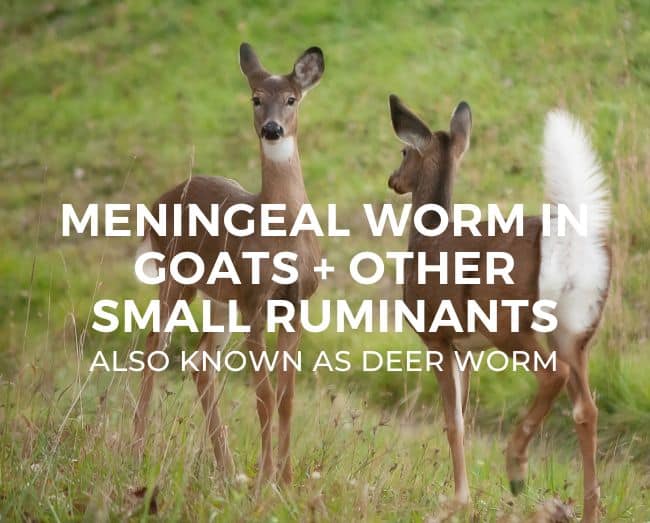
This parasite is carried by white-tailed deer and is often found in areas where water tends to sit, such as low areas or seasonal streams in woods or even pastures. Because of this carrier, meningeal worm is sometimes called deer worm or brainworm.
Because this parasite can be difficult to prevent entirely, the best thing you can do is understand how infection happens, know the early signs to watch for, and act quickly when something doesn’t look right.
This article walks through where meningeal worm comes from, how goats and sheep become infected, what symptoms look like, how diagnosis works, and the current approaches to treatment and prevention.
Table of contents
- Where meningeal worm comes from: deer and snails
- How meningeal worm affects small ruminants
- How to diagnose meningeal worm
- Treatment protocols
- Research on related treatment protocols
- Treating only the affected animals
- Management practices to minimize infection risk
- Deworming as prevention
- Other resources
- Key takeaways
Where meningeal worm comes from: deer and snails
White-tailed deer are the main carriers of meningeal worm, spreading the parasite without ever showing signs of illness. Since deer frequent wooded edges, fencerows, and pastures, they can easily “infect” the area where livestock live. Snails and slugs then pick up the parasite, which is transmitted onto grass and other vegetation where goats and sheep graze.
More details of how this parasite progresses in small ruminants are in the next section.
In a University of Maine study, it was observed that snails and slugs tended to move to the top of vegetation with the onset of dew. Dew stayed longer in shaded areas, increasing populations in these areas.
While white-tailed deer are immune to meningeal worm, moose, elk, and caribou can also become infected. When they do, they often show severe neurologic issues, much like what is observed in small ruminants. Wildlife researchers often find that by the time signs are noticeable, these animals are already in advanced stages and have little chance of recovery (White and Weber, 2023).
How meningeal worm affects small ruminants
The meningeal worm life cycle begins with white-tailed deer spreading the larvae through their manure (stage 1), which can end up in places where livestock graze. In wet areas, the larvae are picked up by snails and slugs. Over 2–3 months, the larvae progress to stage 3, which is what infects small ruminants. This larvae can contaminate vegetation with just a slime trail left behind from the snail or slug.
Once the stage-three larvae are eaten, they move from the stomach toward the spine of the goat. The larvae don’t follow the predictable pathway they follow in deer since goats are considered “abnormal hosts.” Instead, they wander through the spinal cord and sometimes into the brain, irritating and damaging the nerves along the way. Even a small number of larvae can cause serious neurologic problems.
Signs of meningeal worm
As the larvae migrate, they cause inflammation and damage to the central nervous system. Depending on where they travel, the goat may show hind-end weakness, changes in gait, or more advanced neurologic issues.
The damage builds over time, which is why catching early signs is so important. Some animals will recover fully, while others may improve only partially and have permanent mobility changes, like a hitched gait or slight dragging of a back leg. And in some cases, the infection may result in death.
Early signs
- Subtle hind-end weakness
- Changes in gait or stance
- Stumbling or dragging toes, especially when turning
- Slight imbalance or posture changes that may be easy to overlook at first
Progressive signs
- Knuckling or trouble placing the feet correctly
- Noticeable wobbly or uncoordinated movement
- A “dog-sitting” posture
- Full hind-end paralysis
- Front-limb involvement in some cases
- Intense localized itching on one side of the body due to nerve irritation
Less common neurologic signs
- Head tilt
- Circling
- Rapid eye flickering
- Difficulty chewing
- Most affected goats continue eating and maintain a normal temperature, which helps differentiate this parasite from something like listeriosis or meningitis.
Cornell University’s meningeal worm resource page includes a video of a goat showing signs of infection (remember signs may vary by animal), as well as a post treatment video to show the recovery improvement if caught early enough.
How to diagnose meningeal worm
There is no simple on-farm test for meningeal worm in goats or sheep. Because of that, symptoms are your most important indicator. Watching for hind-end weakness, stumbling, itching, or posture changes gives you the best chance of catching it early.
Other look-alike health concerns
Several problems in goats show similar neurologic signs, including listeriosis, polio, rabies, and meningitis. If your goats graze, have access to pasture, or white-tailed deer are present on or near your farm, these neurologic signs are more likely to be from meningeal worm.
Because this parasite can progress quickly, it’s sometimes worth taking a multiple-stage approach, addressing meningeal worm while also considering other diagnoses under the guidance of your veterinarian.
Fecal samples
Meningeal worm cannot be detected by fecal sampling as can many other types of parasites common to small ruminants. The larvae are not shed into the manure of goats or sheep.
Testing for meningeal worm
Right now, there is no reliable live-animal test for meningeal worm in goats or sheep. This is why recognizing symptoms early is so critical.
A definitive diagnosis can be made postmortem by examining the spinal cord or brain. There are some testing options for wildlife species and camelids, and ongoing research may eventually help develop a test for small ruminants.
Working with your veterinarian
If you suspect meningeal worm, contact your veterinarian right away and share the symptoms you’re seeing. Your vet can help you decide how to treat and whether to also address other possible causes.
This article is meant to support that conversation and is not intended to replace veterinary advice, diagnosis, or treatment.
Treatment protocols
The goals of treatment are to stop the larvae from causing more damage, reduce inflammation around the nerves, and support the goat through the recovery process. Early action is important because the longer the larvae migrate, the more damage they can cause.
Commonly used medications
Treatment for meningeal worm varies and is typically known as off-label, meaning guidance is based on research studies or common practices with observed positive results, but the product used does not have instructions on how to dose for a specific health issue and/or livestock species by the veterinary drug manufacturer.
When following these protocols, it is important to work with your veterinarian to determine the best course of action. Print and share this document (Meningeal Worm Fact Sheet) with your veterinarian. It is from the American Consortium for Small Ruminant Parasite Control.
These are the most commonly used medications/dewormers used to address meningeal worm:
Fenbendazole
- Brand names: Safeguard or Panacur
- Often used because it can penetrate the central nervous system and kill the larvae in the spinal cord and/or brain.
Anti-inflammatories
- Used to reduce inflammation and additional damage to the nervous system, often in combination with a dewormer
- Steroids like dexamethasone (do not use in pregnant animals) or NSAIDs such as flunixin meglumine (brand name: Banamine)
Ivermectin (injectable)
- It has been used to treat migrating larvae, but is thought to be only effective when the larvae are in the stomach or abdominal cavity, not once they reach the spinal cord.
Also consider withdrawal times for meat and milk, as dewormers are being used in considerably different approaches compared to what’s listed on the medication bottle. Consult with your veterinarian for further guidance.
Research on related treatment protocols
Cornell University has conducted research related to the off-label use of dewormers and other medications to treat goats and sheep that appear to have meningeal worm symptoms. Based on this research, there are a few approaches that could be taken.
The Cornell study was conducted over a four-year period, comparing two treatment options to evaluate the impact of including ivermectin.
Protocol 1:
- Fenbendazole (25 mg/kg live weight) orally, 5 days
- Ivermectin (0.5 mg/kg) subcutaneous, 5 days
- Dexamethasone (0.2 mg/kg) intramuscular for 3 days followed by 0.1 mg/kg for 2 days
Protocol 2 (Control):
- Fenbendazole (25 mg/kg live weight) orally, 5 days
- Dexamethasone (0.2 mg/kg) intramuscular for 3 days followed by 0.1 mg/kg for 2 days
The study showed that the treatment including ivermectin was statistically significant, meaning the difference between the two outcomes was large enough to indicate it was impactful. Note that because this study did not include a control group without any treatment, the other protocol may still be effective, just not as effective as the treatment including ivermectin.
Learn more about the study here. Very few studies exist on meningeal worm treatment for goats and sheep, use this blog article for educational purposes and consult with your veterinarian when treating your livestock, especially the first time you suspect it.
Treating only the affected animals
If you have a number of goats with meningeal worm, you should consult with your veterinarian about whether you should treat your whole herd or not. Treating goats that aren’t showing symptoms will contribute to parasite resistance (of all parasite types), is expensive given the dosage amount and length of treatment, and time-consuming when treating meningeal worm.
This may be different from how you might handle a typical parasite issue affecting a large portion of your herd. As always, work closely with your veterinarian when deciding on treatment.
From our own farm experience, the best approach has been to treat any goats showing early signs and keep a close eye on the rest of the herd once we see signs during a grazing season. If another goat begins to show symptoms, we start treatment right away with that specific animal. We will typically bring that animal back to the barn in a small pen so they are easier to monitor and treat.
Management practices to minimize infection risk
A research study was conducted by the University of Maine to evaluate management practices to help reduce the risk of meningeal worm on farms with small ruminants. These study findings, along with other university publications and journals, are incorporated below.
Reducing deer access
Limiting deer near your grazing areas can help reduce exposure to meningeal worm. Fencing, livestock guardian dogs, and increased human activity in these areas can all help.
Hunting white-tailed deer (in season) on your farm may also reduce the local deer population.
You can also track deer activity using game trail cameras to see how frequently they’re in your pastures or grazing areas. One camera we use on our farm for observing white-tailed deer is Tactacam’s Reveal camera, which works off cellular service and sends notifications of activity right to your phone in real time.
Reducing snail and slug habitat
Because snails and slugs are part of the middle step in the parasite’s life cycle, managing their habitat is key to reducing the population. Here are a few strategies to consider:
Know your wet areas
Map out where your wet areas are on your farm, especially the areas where you graze your goats. This can include pastures, woods, hayfields, and other brushy areas. Note not just swamps or streams, but any low areas where water may sit or seasonal waterways/dry runs. These areas have the potential to be a hotbed for snails and slugs.
Evaluate your map to determine if there are wet areas that present management concerns not just for parasites but also as high-traffic/use areas. These areas may be worth assessing to determine if an animal walkway should be installed for a dry route, a drain pipe added, or gravel placed around a permanent water source. A consultation with a USDA NRCS conservationist may help assess issue areas and offer potential solutions.
Grazing approach
Manage your grazing herd to avoid these historically wet areas in general. This may mean fencing out access to certain areas with portable fencing, skipping areas entirely, and/or mowing certain areas down low so they are unappealing for goats to graze. At a minimum, avoiding these areas in your rainy seasons or after fall sets in (leaves have fallen) may decrease infection (ACSRPC).
Based on observations during the University of Maine study, snail/slug populations may be less prevalent during dry seasons or droughts, but that doesn’t mean meningeal worm can’t be picked up.
Mowing and other vegetation management
Keeping vegetation in wet areas low can help reduce snail/slug populations. The University of Maine research study showed that snails and slugs tend not to thrive in short vegetation. The study used intensive mowing, keeping the wet-area vegetation no higher than 6 inches. This was done over two grazing seasons/years, with snail and slug populations recorded lower over time, with statistically significant results (meaning a meaningful difference for the action in place).
The first season after forest or brush clearing can be a higher risk (ACSRPC).
When managing meningeal worm for wildlife species, it has been suggested to reduce snail and slug populations with controlled burns (White and Weber, 2023).
Forage management and type
While soils and pastures that retain moisture are good for soil health and maintaining a productive stand of forage throughout the growing season, this environment if too wet can also lead to increased snail/slug populations. It’s a delicate balance to manage your pastures effectively and protect the health of your livestock.
The University of Maine study researchers suspected that broad-leafed plants with deep taproots, such as burdock and dandelion, help maintain environments for snails and slugs to thrive even during droughts. There tended to be fewer populations observed in areas with more grasses and clovers.
Pastured poultry
Pastured poultry (chickens) has been shown to significantly reduce snail and slug populations (University of Maine). In the study, about 200 laying hens (foraging breeds) were managed in a rotational grazing approach followed by small ruminants.
Ducks are not recommended for the purpose of reducing meningeal worm based on findings in a related University of Maine study. Larvae can sometimes pass through ducks and reinfect pastures.
Deworming as prevention
Routine preventive deworming for meningeal worm is not recommended. Frequent ivermectin and/or fenbendazole use can contribute to resistance in stomach worms, making those parasites harder to manage. Preventive treatments should only be used under veterinarian guidance.
Other resources
- Deer worm in goats (podcast). (2021). Episode 34. For the Love of Goats.
Key takeaways
- Meningeal worm is a serious parasite that goats and sheep can pick up accidentally while grazing, especially in areas where deer and snails overlap.
- This parasite doesn’t respond to traditional deworming routines or the grazing strategies used for typical stomach worms.
- Knowing the early signs and acting quickly is your best chance at helping an affected animal recover.
- Prevention focuses on reducing deer access, managing snail and slug habitat, and staying alert to symptoms during high-risk periods.
- Total prevention is difficult, but understanding how the parasite works helps you make better decisions for your herd’s health.
- Always consult with your veterinarian on diagnosing and treating your livestock
References
- Gerhold, R. and Richards, J. (2023). Parasitic worms bury themselves in the brains of moose and elk – a new test can help diagnose these animals to prevent disease spread. The Conversation.
- Deer worm factsheet, prepared for sheep and goat producers. Cornell University.
- Stanton, t. and Buckner, S. (2022). Other Worms: meningeal worm. American Consortium for Small Ruminant Parasite Control (ACSRPC).
- Slapeta, J. (2024). Nematodes causing CNS disease in animals. Merck Veterinary Manual.
- White, R. and Weber, J. (2023). Reducing risks of wildlife–livestock parasite transmission (SARE Final Report). University of Maine.


We are in Northern Vermont, and we’ve had instances of meningeal worm the past two years. I’d like to share our experience with symptoms and treatment in the hope that others can successfully catch and treat this horrible parasite before it causes death or permanent damage!
The first sign we have seen, before any neurological signs like dragging legs, is excessive itching, especially at the neck near the back of the head and near the spine. Goats will scratch so much they will wear away their fur in those places.
Last year, we didn’t know what it was at first, and we had some losses and permanent neurological damage to some of the survivors. This year, we treated animals with Fenbendazole at 10 times the label dose as soon as we identified symptoms. The animals recovered, and we did not need to treat a second time.
One goat in our herd was exposed to and treated for meningeal worm last year, and he did not have any recurrence of symptoms this year (and did not receive treatment this year). We found this very promising! I had heard that animals can build up an immune response to fight off the parasite. We’re hopeful that all animals who were exposed this year will be able to fight off the worms next year without needing dewormers.
Kelly Thank you for sharing your experience with meningeal worm. It’s the worst. I’m glad you’ve had positive results with your treatment. As a farmer it’s so hard to see animals struggle, and it feels good when we can actually recover from something this severe.