

Rotational grazing can save time, but only if your infrastructure works with you instead of against you.
I’ve learned the biggest labor savings don’t usually come from buying more equipment. It comes from having systems in place that make everyday grazing tasks faster and easier.
When we’re moving goats and sheep daily to every few days, there are four areas that have the biggest impact on labor:
- Fencing
- Water
- Shelter
- Supplies kept on hand
None of these systems need to be complicated. In fact, simpler is often better. The goal is to spend less time hauling equipment, fixing problems, and making extra trips back to the farmstead.
Portable grazing infrastructure isn’t necessarily about buying more equipment. It’s about choosing systems that fit your farm, your livestock, and how often you’ll realistically move animals.
Here are the portable grazing infrastructure investments that have saved us the most time during grazing season.
Portable fencing that matches your grazing style
If moving fence takes too long, you’ll be tempted to move animals less often.
For us, portable fencing has to balance three things:
- Containing goats reliably
- Being easy to move
- Being durable enough to survive daily use
It’s also important to acknowledge that rotational grazing will always require labor. Portable infrastructure can reduce labor, but it doesn’t eliminate it entirely.
Sometimes I see people looking for ways to completely avoid moving fence, water, or animals. If the goal is to eliminate those tasks altogether, regenerative grazing practices may not be the right fit. Rotational grazing requires active management. The goal isn’t to remove the work, it’s to make that work more efficient and worthwhile.
Good infrastructure helps reduce unnecessary labor so you can spend your time on grazing management and observing animal health needs rather than constantly fighting equipment, repairing systems, or making extra trips across the farm.
When I’m planning portable fencing, I’m not just thinking about today’s paddock. I’m also thinking about where we’ll be grazing next and how livestock will move through the farm over the coming weeks and months.
Whenever possible, I’m building fence for the current paddock in a way that can become part of the next paddock. This reduces the amount of fencing that needs to be moved while also creating a smoother flow for livestock movement.
I’m also thinking about the larger seasonal picture. How will animals get to the next field or pasture? How will they eventually return to the barn for winter? Where will we set up a corral or catch area if needed?
Without planning ahead, it’s easy to end up grazing livestock in a remote area of the farm that creates challenges later when animals need to be gathered, loaded into a trailer, or moved back toward winter facilities. This can be especially challenging on farms with wooded grazing areas where livestock trailers or larger equipment may not have easy access.
The type of fencing we use depends heavily on the location.
When we’re grazing open hayfields or pasture, polywire or all-in-one systems such as SmartFence work well. These systems can be set up and taken down quickly, making paddock moves efficient. We also aren’t dealing with as many issues from falling branches, trees, or wildlife interactions.
When we’re grazing in the woods, we often use electric net fencing instead. It takes longer to set up initially, but it tends to perform better when dealing with wildlife pressure, deer movement, and falling branches. If a branch falls on part of the fence, netting often continues to provide a physical barrier until the problem can be fixed.
One thing that helps reduce labor in wooded grazing areas is continually improving the fence paths. Clearing brush, trimming vegetation, and removing obstacles makes future fence setup much easier. Those small improvements compound over time and can save significant labor year after year.
In some wooded grazing situations, a wagon-wheel paddock design can work particularly well. Rather than moving all of the infrastructure every time animals move, water, minerals, and shelter can remain in a central location while fencing is adjusted around them. We occasionally use this approach in some of our hayfield grazing systems as well.
A portable water system eliminates unnecessary trips
Water is often one of the biggest hidden labor factor in a grazing operation. Animals need reliable access to clean water, but once they move away from the barn, getting water where it’s needed can quickly become a daily chore.
Without a plan, it’s easy to end up spending a lot of time dragging hoses, checking tanks, and making repeated trips just to keep water available. A good portable water system is designed to bring water to the animals in a way that’s consistent, reliable, and easy to manage.
A portable water system can include:
- Livestock water tanks
- Float valves
- Portable water trailers
- Quick-connect fittings
- Seasonal water lines
There are a couple of different approaches that can work well, depending on your farm layout and water access.
A portable water trailer typically includes a bulk water tank mounted on a trailer that feeds a livestock tank with a float valve. This setup allows you to haul water to wherever animals are grazing and keep a tank filled without constant monitoring. It’s especially useful in areas where running a water line isn’t practical or where grazing locations change frequently.
A seasonal water line is a more semi-permanent option. This usually involves running poly pipe from a water source, such as a hydrant at the barn, out to the areas where you plan to graze. The pipe can be laid above ground for the season and doesn’t need to be buried. At different points along the line, you can install outlets where a short hose, livestock tank, and float valve can be connected.
With this setup, you’re only moving a small hose and tank as animals rotate through paddocks, rather than constantly dragging long garden hoses. At the end of the season, the line can be drained if you’re in an area where freezing is a concern.
Both systems reduce the number of trips needed to monitor and refill water tanks and provide flexibility as paddock locations change throughout the season.
During hot weather, having water readily available where the animals are grazing becomes even more important. A portable system helps ensure animals always have access to water without creating additional work every day.
Portable shelters reduce management headaches
Portable shelters only save labor when they’re truly easy to move. When we think about shelter during grazing season, ease of movement is one of the most important considerations. If moving a shelter requires significant equipment, multiple people, or a large amount of time, it often becomes something that gets left behind.
We’ve used a variety of shelter options over the years, including:
- Calf hutches
- Portable shelters on skids
- Natural shelter from trees and wooded areas
In some situations, natural shelter is actually the lowest-labor option. When goats have access to wooded areas, tree lines, or natural windbreaks, they often make excellent use of those areas during hot weather, rain, and windy conditions.
When portable shelters are needed, I prefer options that can be relocated easily as animals move from paddock to paddock. The goal is to provide protection from the elements without creating another major task every time the herd is moved.
The supplies that prevent extra trips
One of the biggest labor savers on our farm isn’t a piece of infrastructure at all. It’s having the right supplies with us when we’re already out in the pasture.
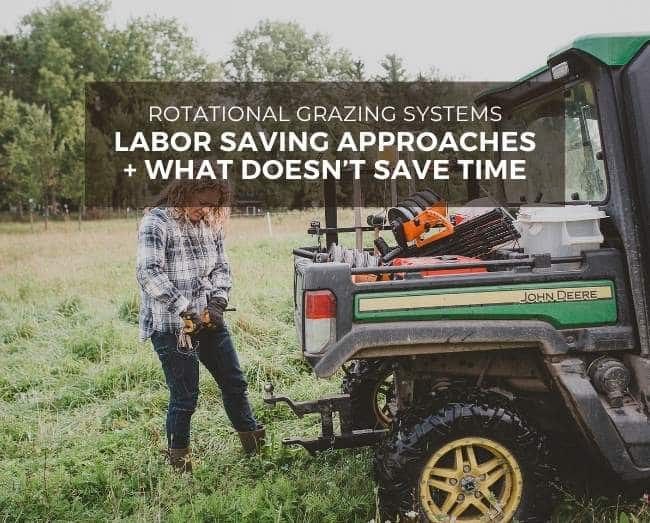
Every trip back to the shop, barn, or house costs time. That’s why I keep a variety of grazing-season supplies in our John Deere Gator.
Some of the items that regularly earn their place include:
Note: the links above are Amazon affiliate links, which I earn a commission, but at no cost to you. I only share products I use.
Most of these items aren’t used every day. But when you need them, having them immediately available prevents small problems from turning into larger ones.
The handheld weed trimmer is useful for cutting problem species such as thistle, burdock, and wild parsnip. It can also help cut a path for a new portable fence when needed.
A fault finder helps identify fence issues quickly rather than spending time walking the entire fence line trying to locate a problem. Marking tape helps identify temporary boundaries, gates, or areas that need attention later.
Simple items like spray vet bandage and livestock marking paint make it easier to address animal health or management tasks while you’re already in the pasture.
None of these items save much time individually. Collectively, however, they eliminate countless extra trips throughout the grazing season.
What doesn’t save labor
Not every portable grazing system actually reduces labor. Some infrastructure looks efficient on paper but becomes difficult to manage in practice, especially when grazing goats that require frequent pasture moves.
One example is moving cattle panels and T-posts. While they certainly have uses on farms, they can be heavy, awkward, and time-consuming to relocate on a regular basis.
I often see smaller-scale farmers and homesteaders gravitate toward cattle panels because they’re unfamiliar with electric fence or feel intimidated by it. There’s a perception that electric fencing is complicated or difficult to troubleshoot.
In reality, a well-designed electric fence system is usually much easier to manage than hauling cattle panels around a pasture. A strong energizer, adequate grounding rods, good connections, and routine maintenance go a long way toward creating a reliable system.
Once the basics are understood, portable electric fencing often becomes one of the most efficient tools available for rotational grazing.
The same can be true for large three-sided sheds. Even though they can technically be moved, they’re often better suited for permanent locations. Their size and weight frequently require larger equipment, which isn’t always practical when grazing in woods, rough terrain, or wet conditions.
Portable all-in-one pen systems can create similar challenges.
Many homesteaders and small-scale farmers are familiar with chicken tractors, where the entire shelter and enclosure are moved together as one unit. That approach can work well for poultry because the birds are often moved once or twice per day and require a relatively small grazing area.
Goats are different. To achieve the benefits of rotational grazing while maintaining adequate feed access and protecting pasture health, goats need access to more fresh forage. If you’re trying to accomplish that by pulling an entire portable pen system, you may find yourself moving the structure far more often than expected.
In some situations, those systems may need to be moved four to six times per day to provide the same grazing benefits while preventing overgrazing, maintaining forage availability (enough feed for your goats), and protecting soil health.
Rather than moving an entire shelter and enclosure repeatedly, many grazing operations find it more efficient to use lightweight portable fencing while allowing water, minerals, and possibly a shelter to remain in place longer or move independently as needed.
Another consideration is the equipment required to move infrastructure. Larger systems often require larger tractors or heavier equipment. That can make it difficult to access certain areas of the farm, particularly wooded paddocks. It can also create ruts, soil compaction, or even equipment getting stuck during wet conditions.
In many situations, infrastructure that can be moved with an ATV, UTV, or compact tractor ends up being much more practical.
Water systems can create similar labor challenges. Constantly rolling out and putting away long hoses can become surprisingly time-consuming. Larger portable tank trailers or seasonal waterline systems often require more planning initially, but they can save substantial labor throughout the grazing season and are often fairly straightforward to build yourself.
Key points
Rotational grazing will always require labor. Animals need to be moved, fences need to be checked, and water systems need to be maintained. But the right portable infrastructure can dramatically reduce the amount of time required to do those jobs.
For us, the biggest labor savings have come from portable fencing, movable water systems, practical shelter options, and keeping essential tools close at hand.
None of these systems are complex. But they save time every single week of grazing season. And when grazing season is already busy enough, those saved minutes add up fast.
FAQs: Labor savings with grazing
The best portable fencing depends on your farm layout, terrain, and management style. Many goat farmers use electric netting, polywire, or all-in-one systems such as SmartFence. The most effective system is usually the one that contains goats reliably while remaining easy to move.
Many farmers use portable water trailers, seasonal water lines, livestock tanks, and float valves. The goal is to bring water to the animals rather than forcing animals to travel long distances to access water.
Not always. In some situations, natural shelter from trees, wooded areas, and windbreaks may provide adequate protection. When portable shelters are used, lightweight options that can be moved easily tend to work best.
Common supplies include a fault finder, marking tape, livestock marking paint, spray vet bandage, jumper cables, and tools for vegetation management. Keeping supplies nearby reduces trips back to the barn or shop.
A wagon-wheel system uses a central hub where water, minerals, and sometimes shelter remain in place while fencing is adjusted around them. This can reduce labor because not all infrastructure needs to be moved with every paddock change.


What a great article! You touched all the important topics well. This will be a great reference to share with people who are purchasing starter flocks of sheep from us. I usually give them an info sheet with items we use and a small description, but this will be a great link to share with more details! Thanks!
Thank you Emily! Glad you found it helpful.