




It isn’t often meat goats receive attention from a major national newspaper. The Washington Post recently published a feature highlighting the growing U.S. meat goat industry. Using the Madison Livestock Exchange in Virginia as its backdrop, the article covers the increasing demand for goat meat and why more farmers are adding goats to their operations.
Overall, the article does a good job introducing readers to a part of the livestock industry that is often overlooked. It highlights many of the factors driving today’s market, including rising consumer demand, higher auction prices, and the growing interest among farmers in raising goats.
As I read through the story, I kept coming back to one question: If demand for goat meat has been growing for years, why hasn’t U.S. production kept pace?
It’s a question I’ve been thinking about and observing for many years as someone who raises meat goats, sells goat meat directly to customers, follows industry trends, and talks with other goat farmers and ranchers across the country.
The answer is more complicated than simply producing more goats.
The Washington Post story opens the door to that conversation. I’d like to add context from my own experience and from conversations with other producers to help explain some of the opportunities and challenges shaping today’s U.S. meat goat industry.
A livestock auction offers one view of today’s meat goat industry
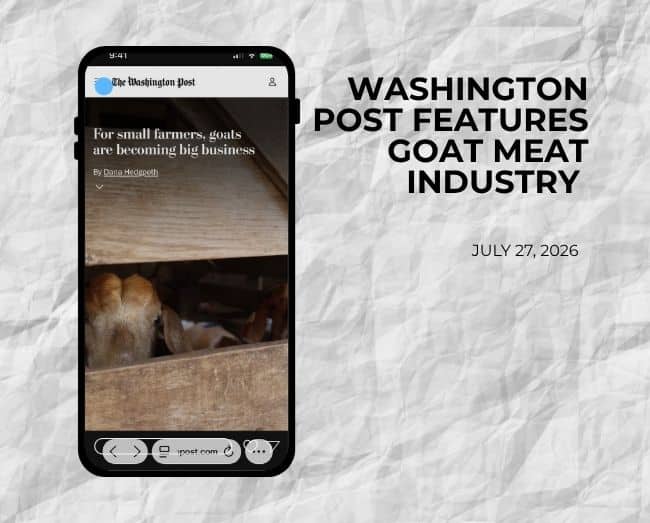
The Washington Post article centers around the Madison Livestock Exchange in Orange, Va., using one sale day to introduce readers to the U.S. meat goat industry. Through producers, buyers, auction staff, and livestock trailers lining up outside the sale barn, readers get a glimpse into how goats move through one part of the marketing system (in a traditional livestock market) and why demand has changed in recent years.
The article also highlights how buyer demand has remained strong. Demand from diverse communities, particularly around cultural and religious holidays, has contributed to higher prices and increased interest in raising meat goats. The story does a good job explaining why more farmers are beginning to look at goats as another livestock enterprise.
While livestock auctions continue to play an important role in the industry, they represent just one marketing avenue available for meat goats.
Many farmers and ranchers are (or have an interest in) building businesses beyond the traditional sale barn. This includes marketing goat meat directly to consumers or restaurants, while others focus on breeding stock, vegetation and brush management services, or even agritourism. Rather than relying solely on auction prices, these business enterprises often allow producers to diversify their income and have greater influence over the prices they receive for their products or services.
One theme I’ve noticed through conversations with goat farmers and ranchers, both in person and online, is that raising goats is only part of building a successful operation. Marketing is often the bigger challenge.
Many producers invest a lot of time learning about genetics, nutrition, fencing, grazing, and animal health. But once those goats are ready to sell, questions start to emerge.
- Which marketing channel is the best fit?
- Should I sell through a livestock auction or market directly to customers?
- Is there enough local processing capacity?
- How do I build a customer base?
- Can I create more value by offering breeding stock or grazing services instead of selling every animal through the sale barn?
These questions illustrate that a strong market for goat meat doesn’t automatically translate into a profitable business for every farm. Successfully raising goats and successfully marketing them require two different skill sets.
Demand continues to grow, but production hasn’t kept pace
One of the strongest points made in the Washington Post article is that consumer demand for goat meat continues to increase. Buyers at the auction describe difficulty finding enough market-ready goats, while producers and Extension educators point to growing demand from Hispanic, Muslim, African, and other communities where goat meat has long been part of cultural traditions and holiday celebrations.
That growing demand isn’t new. For years, the United States has imported the majority of the goat meat consumed domestically because U.S. producers have been unable to supply enough product to meet consumer demand. The Washington Post notes that roughly 60 to 70 percent of the goat meat consumed in the United States is imported.
I’ve written previously about Australia’s goat meat industry and its growing role in supplying the U.S. market. In 2025, Australia exported a record 61,766 metric tonnes (136.2 million pounds) of goat meat worldwide, with the United States remaining its largest export customer. Those record export volumes underscore just how dependent the U.S. market continues to be on imported goat meat to satisfy consumer demand.
At first glance, this seems like a straightforward economic opportunity. Consumer demand is growing. Auction prices are strong. Imports continue to fill the gap.
So why aren’t more U.S. farmers raising meat goats? Part of the answer is that demand alone isn’t enough to build an industry.
I’ve had conversations with producers who have worked through the challenges of learning how to raise and manage a productive goat herd, only to find that a new set of challenges begins once those goats are ready to sell. They ask how to find USDA-inspected processing, where to market finished animals, whether they should sell through a livestock auction or directly to consumers, and how to build a customer base willing to pay for locally raised goat meat.
Those business challenges don’t receive as much attention as consumer demand, but they often determine whether a meat goat enterprise becomes financially sustainable. Farmers and ranchers who have greater control over both their income and expenses are often in a better position to improve profitability and, just as importantly, actually make a profit. Strong consumer demand and healthy sales don’t automatically translate into a profitable business. The ability to manage costs while making intentional business decisions often determines whether an operation finishes the year in the black or simply generates revenue without earning a profit.
Why more producers are interested in goats
Another point the Washington Post article highlights well is why goats appeal to many farmers. Compared to cattle, goats generally require less land, browse brush and woody vegetation that other livestock often ignore, and have lower purchase costs. For diversified farms, they can provide another source of income while helping manage vegetation.
I agree with that assessment, but I also think this is where additional context is helpful. Lower startup costs don’t necessarily mean goats are an easy livestock enterprise or an inexpensive one to manage.
It’s easy to look at strong auction prices or growing consumer demand and assume meat goats are an easy way to make money. In reality, experienced goat producers know there are many ongoing costs that are often overlooked.
Feed is one example. While goats can be raised on pasture alone, many producers choose to supplement with grain to increase rate of gain or finish animals more quickly. That strategy may improve growth, but it also increases production costs. When feed prices rise, those additional expenses can add up quickly and affect overall profitability.
Feed is only one piece of the equation. Labor, fencing, livestock guardian dogs, veterinary care, parasite control, minerals, equipment, transportation, and processing costs (if direct marketing) all contribute to the total cost of raising goats. These operational costs reinforce an important point: meat goats aren’t an “easy money maker.” Like any livestock enterprise, long-term success depends on understanding both production costs and the business decisions that affect profitability.
None of this means goats aren’t a good fit for many farms. I believe they offer tremendous opportunities, particularly when they complement an existing livestock operation or fit within a well-developed business plan.
At the same time, I think it’s important that prospective producers understand both sides of the equation. Meat goats aren’t an “easy money maker.” Like any livestock enterprise, long-term success comes from strong management, intentional business decisions, and building an operation that is financially sustainable, not simply responding to strong consumer demand.
Why hasn’t the industry expanded faster?
If you only looked at consumer demand, it would seem logical that the U.S. meat goat industry should have expanded much more rapidly over the years.
Demand has continued to grow. Prices have generally remained strong. Consumers are looking for more locally raised goat meat, and imports continue to fill much of the gap.
Yet despite those market signals, the domestic industry has grown more slowly than many expected. The answer isn’t a lack of opportunity. Instead, it’s a combination of production, infrastructure, labor, and business challenges that make expansion more complicated than simply adding more goats.
Processing and market infrastructure remain major bottlenecks
If consumer demand for goat meat is strong, why aren’t more producers expanding? One of the biggest reasons is that producing more goats is only one part of the equation. Those goats still need to move through a supply chain that includes processing, meat fabrication, distribution, and ultimately consumers.
The Washington Post article touches on processing, but I think it’s one of the industry’s biggest challenges and deserves additional discussion.
For producers selling directly to consumers, finding access to USDA-inspected processing can already be difficult. In many parts of the country, appointments must be scheduled months in advance, and producers may haul animals several hours to reach a processor equipped to harvest goats. Those longer trips increase transportation costs, require additional time away from the farm, and add another expense to an already tight margin.
The challenge extends beyond direct-to-consumer sales. Many producers are interested in selling goat meat wholesale to restaurants, grocery stores, distributors, or larger foodservice buyers. Those markets can represent significant opportunities, but they also require a different level of infrastructure.
Some wholesale buyers coordinate processing themselves, while others expect producers to arrange it. Either way, relatively few larger processing facilities are equipped to efficiently handle small ruminants. Most commercial meat plants were designed around cattle or hogs. Goats are smaller in size and can be more challenging to manage in these facilities.
Scale is another factor shaping the industry. Compared to the beef, pork, and poultry industries, the U.S. meat goat industry is made up of many smaller farms and ranches. While there are certainly larger commercial operations, much of the industry remains relatively fragmented. That can make it more difficult to assemble consistent volumes of market-ready goats, attract investment in processing and distribution infrastructure, and efficiently serve larger wholesale buyers.
Another challenge is consistency. Restaurants, grocery stores, distributors, and institutional buyers often want goats that meet consistent specifications for weight, quality, and quantity throughout the year. When buyers are sourcing goats from many different farms, achieving that level of consistency becomes more challenging. Purchasing a handful of goats from multiple livestock auctions may help fill short-term demand, but it doesn’t always provide the reliable supply larger buyers are looking for. Those buyers often prefer to source larger groups of similarly sized animals from established producers or coordinated supply networks.
At the same time, relatively few commercial meat goat operations currently produce enough goats to consistently meet those needs. Pair that with limited processing capacity and an underdeveloped go-to-market infrastructure, and it becomes easier to understand why imports continue filling much of the gap between consumer demand and domestic production.
Building a business around market opportunities
The Washington Post article highlights growing demand and stronger prices, but one of the questions I continue hearing from goat producers is, “Now that I’ve raised the goats, what’s the best way to market them?”
There isn’t one right answer. Instead, successful producers build businesses around market opportunities that fit both their local market and their farm operation.
That begins with research. Who is buying goat meat in your area? Are there restaurants looking for locally raised goat meat? Wholesale buyers? Independent grocery stores? Ethnic markets? Food distributors? Livestock auctions? Metro areas?
Just as important, what can your farm realistically produce?
Some operations may be well suited to selling directly to consumers, while others may be a better fit for supplying wholesale buyers or selling through livestock auctions. Each marketing channel has different expectations, infrastructure requirements, labor needs, and pricing structures.
Rather than chasing whichever market appears to have the highest prices, producers often have greater long-term success by identifying opportunities that align with their production system, available labor, processing options, and business goals.
Education continues to shape the industry’s growth
The Washington Post article highlights more farmers becoming interested in meat goats. More new producers continue to enter the industry because they recognize the market opportunities goats can offer.
But goats also have a learning curve.It can take quite a bit of time to develop a good feel for fencing, rotational grazing, nutrition, parasite control, breeding, kidding management, predator management, and marketing. Many of these skills are learned over a longer time frame rather than during a single production season.
While educational resources are limited, universities, Extension educators, producer organizations, and others are providing foundational materials and training to help producers get started and continue improving their operations.
Where there’s both a gap and an opportunity is bringing meat goat farmers and ranchers together on a broader national level. Meat goats do not have a federal research and promotion program or a federal marketing order through the USDA like some other agricultural commodities (beef or lamb as an example).
Programs like these help support producer-funded research, consumer education, industry promotion, and market development. Similar efforts for the U.S. meat goat industry could help increase consumer awareness of goat meat, strengthen relationships with the foodservice sector, and support the long-term growth of the industry.
One industry doesn’t fit every region
Another challenge that’s easy to overlook is how different the meat goat industry looks across the United States. Consumer demand, processing access, available pasture, climate, predators, forage resources, and marketing opportunities vary considerably from one region to another.
A production system that works well in Texas, where goat production has been established for generations, may look very different from one in Wisconsin, New York, or Virginia.
The same is true for marketing. Some regions have well-established livestock auctions with strong buyer competition. Others may have greater opportunities for direct-to-consumer sales, wholesale marketing, or supplying restaurants and independent retailers.
Recognizing those regional differences is important because there isn’t one blueprint for building a successful meat goat business.
Imports continue filling the gap
Until domestic production grows enough to consistently meet consumer demand, imported goat meat will likely continue playing an important role in the U.S. food supply.
Australia has become the dominant supplier, exporting record volumes of goat meat to the United States in recent years. That reflects the reality that building a domestic livestock industry takes time.
Expanding goat numbers is only one part of the equation. The industry also needs processing capacity, transportation networks, market development, educational resources, and profitable businesses that encourage long-term investment.
Until more of those pieces are in place, imports will likely continue filling much of the gap between growing consumer demand and domestic production.
References
- Hedgpeth, D. (2026, July 27). For small farmers, goats are becoming big business. The Washington Post. https://www.washingtonpost.com/dc-md-va/interactive/2026/07/27/small-farmers-goats-are-becoming-big-business/
- Svacina, L. (2026, July 15). Australian goat meat exports hit another record. What it means for the U.S. market. Grazing with Leslie. https://grazingwithleslie.com/marketing-meat-goats/australian-goat-meat-exports-2025/


I enjoy reading your research. Thanks!