




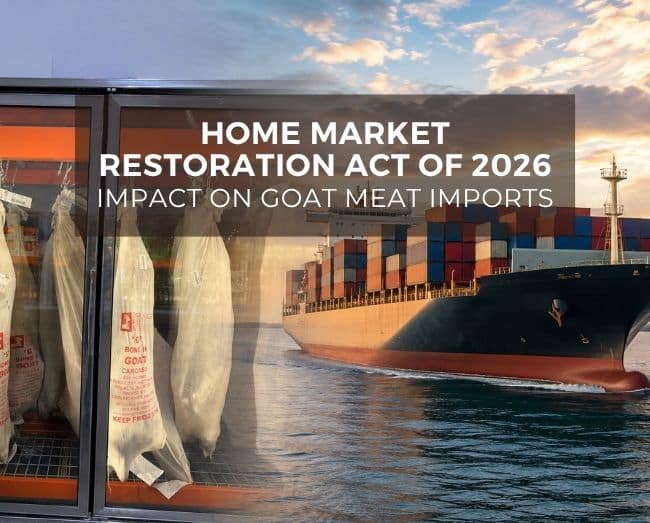
Note: This legislation was introduced in June 2026 and has not been enacted into law. As with any proposed legislation, provisions may change as the bill moves through Congress.
A newly introduced piece of federal legislation could significantly change how goat meat imports enter the United States and potentially impact the growth of our domestic goat meat industry.
On June 25, 2026, Senator Bill Cassidy (R-Louisiana) introduced the Home Market Restoration Act of 2026, legislation that would establish new tariff-rate quotas and increase import duties on several agricultural products, including goat meat, lamb/sheep meat, beef, live cattle, honey, shrimp, rice, crawfish products and catfish fillets.
While the legislation groups goat meat and lamb/sheep meat together under the same tariff and quota structure, this article focuses specifically on the potential implications for the U.S. goat meat industry.
For goat meat, the proposal represents one of the most significant changes to import policy in decades.
Proposed goat meat import tariffs
The bill would establish a new duty rate of $2.76 per kilogram (approximately $1.25 per pound) on imported goat meat and lamb/sheep meat entering the United States.
The legislation covers all oat meat and lamb/sheep meat classified under Harmonized Tariff Schedule (HTS) codes 0204.10.00 through 0204.50.00.
Current tariff rates on imported goat meat have remained largely unchanged for decades and do little, if anything, to protect U.S. goat producers from growing imports.
Proposed goat meat import quota
While the legislation establishes a combined quota for oat meat and lamb/sheep meat imports, the quota would directly impact goat meat entering the United States. Under the proposal, a specified quantity of imported oat meat and lamb/sheep meat would be allowed to enter under the lower tariff rate each year, with substantially higher duties applied to imports above the quota.
The proposed annual quota levels are:
| Year | Maximum sheep and goat meat imports under quota |
| 2027 | 295.0 million pounds (133.8 million kg) |
| 2028 | 274.9 million pounds (124.7 million kg) |
| 2029 | 257.1 million pounds (116.6 million kg) |
| 2030 | 240.1 million pounds (108.9 million kg) |
| 2031 | 224.0 million pounds (101.6 million kg) |
| 2032 | 209.0 million pounds (94.8 million kg) |
| 2033 | 195.1 million pounds (88.5 million kg) |
| 2034 | 182.1 million pounds (82.6 million kg) |
| 2035 | 169.8 million pounds (77.1 million kg) |
| 2036 | 159.0 million pounds (72.1 million kg) |
The quota would gradually decline over a ten-year period.
Any sheep or goat meat imported above the annual quota would be subject to a substantially higher duty of $11.02 per kilogram (approximately $5.00 per pound).
Analysis of impact on goat meat industry
While this proposed legislation is a good step forward for our country’s goat meat industry, the proposed tariffs and quotas will likely not make a large enough impact to actually strengthen the U.S. domestic goat meat supply.
Currently, the U.S. is the largest importer of goat meat from Australia, which is the largest exporter of goat meat in the world. In fact, last year (2025), imports grew by 40% to 29,649 tonnes swt (65.4 million pounds), a record quantity for Australian exports to a single market (MLA, 2026).
In comparison, the proposed legislation sets a combined sheep and goat meat import quota of approximately 295.0 million pounds in 2027. The quota gradually declines each year, reaching approximately 159.0 million pounds by 2036. The quota represents the total amount of sheep and goat meat that can be imported before the substantially higher over-quota tariff of $5.00 per pound would apply.
Aside from the large gap between the existing goat meat imports into the U.S. and the proposed quotas, there are a number of other factors that may still prohibit the growth of our domestic goat meat industry. Those include:
Retail prices will still continue to have a large gap between imports vs. domestic supply
There is still a large spread in price between imported goat meat and domestic goat meat. Goat meat raised in the U.S. sells for about $19-$30/lb. (Miller), while imported goat meat from Australia is about $5.33/lb. at Costco (Svacina).
If the tariffs were implemented, adding approximately $1.25 per pound, the imported retail price would increase to roughly $6.58 per pound, assuming the additional cost is passed on to consumers. That would still leave a price gap of approximately $12.42 to $23.42 per pound between imported and domestically raised goat meat.
If the import quotas were met, the $5/lb. imposed tariffs on imports above the quota would then go into place. It’s likely this added cost would be passed on to consumers as well, bringing the retail price to approximately $10.33 per pound. The price gap does get closer; however, it is hard to anticipate if goat meat imports would even meet the stated quota levels, even with record imports from Australia.
Note: Costco pricing is used as an example because the USDA does not comprehensively track retail goat meat prices. Additionally, goat meat is not readily available in most grocery stores, while Costco carries it in many locations.
The U.S. goat meat industry is young
While there is growth in the number of meat goats raised in the U.S., the industry itself is very young and disjointed. There are very few large-scale go-to-market avenues, only a handful of major processors harvesting and marketing goat meat, and many buyers at local livestock markets purchasing for only regional markets.
Additionally, farmers and ranchers raising meat goats have very little power as a whole compared to their peers raising other livestock species. There is a lack of producer-run associations at the national and state level to focus on marketing goat meat. Regionally, some exist, but most groups tend to focus on breed-specific efforts from a production and show standpoint. There may be some focus on goat meat itself, but it’s not at the scale it should be compared to other livestock species.
The other factor that comes into play is there is not a USDA research and promotion board for goat meat, as there are for other livestock species and commodities. While some may argue they don’t want the government involvement within this segment of the industry, it does greatly impact the retail marketing efforts the goat meat industry could be doing to promote our domestic goat meat. Many of these research and promotion boards have been at work for 60 years, since 1966 (USDA).
There simply isn’t enough scale or coordination to allow the domestic goat meat industry to effectively compete. This puts U.S. goat producers at a disadvantage, even if the price spread become smaller.
Future impact of proposed legislation
As noted above, there will likely not be much of a shift to using domestically raised goat meat at a broader scope if these proposed quotas and tariffs go into effect. The U.S. is already importing record volumes of goat meat from the world’s largest goat meat exporter, Australia.
Other industry efforts will need to happen, especially outside the farm gate. As imported goat meat prices continue to increase, there may be more incentive for investment into growing and strengthening the goat meat industry in the U.S.
Additionally, more large-scale producer-driven efforts on promoting goat meat and collaboration with USDA’s research and promotion efforts would help move the industry forward.
What can you do?
While this proposed legislation may not be quite at the right scale, it is an effort in the right direction.
Contact the office of Senator Bill Cassidy (R-Louisiana) and thank him for his efforts in proposing the Home Market Restoration Act of 2026 and including goat meat in the legislation. Note that meat goats and goat meat are often overlooked when it comes to USDA programs and efforts to market U.S. agricultural commodities.
Provide a brief background about your involvement in the goat meat industry. If you believe changes should be made to the proposed quota or tariff levels, include those suggestions along with your reasoning.
Contact your state Senators and ask for their support for this proposed Act. Use similar messaging as you did with the letter to Senator Cassidy. You can find your Senators here: https://www.senate.gov/senators/
Letters or emails will work. While you may feel like you are one person, know that your elected officials want to hear from you and get feedback so they can support their constituents.
Sources
- Cassidy, B. (2026). Home Market Restoration Act of 2026 (119th Congress, 2nd Session).
- Miller, L. (2024). Get Your Goat. Offrange. Retrieved from https://ambrook.com/offrange/livestock/the-other-red-meat-no-not-that-one
- Meat & Livestock Australia. (2026). Goatmeat global snapshot: Market insights. Retrieved from https://www.mla.com.au/overseas-markets
- R-CALF USA. (2026, June 25). Ranch group applauds legislation to reform tariffs and quotas affecting U.S. cattle and sheep producers. Retrieved from https://www.r-calfusa.com/
- Svacina, L. (2026). Australian goat meat in Costco warehouses. Grazing with Leslie. Retrieved from https://grazingwithleslie.com/marketing-meat-goats/costco-goat-cubes/
- U.S. Department of Agriculture Agricultural Marketing Service. (n.d.). Research and promotion programs. Retrieved from https://www.ams.usda.gov/rules-regulations/research-promotion


LEAVE A COMMENT
Comments