




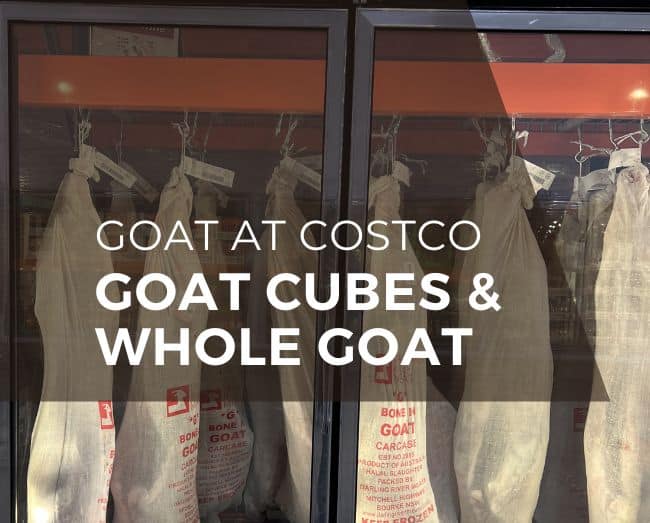
Goat meat is becoming more visible at Costco. Many families are specifically looking for Costco goat cubes, which are sold in 15-pound boxes alongside whole frozen goats. Most this goat is imported from Australia.
If you’ve seen it in the freezer and wondered what it is, where it comes from, or why the price looks the way it does, here’s a closer look at what Costco carries and how it compares to goat raised in the United States.
Table of contents
What type of goat meat does Costco offer
Whole goats (entire carcasses)
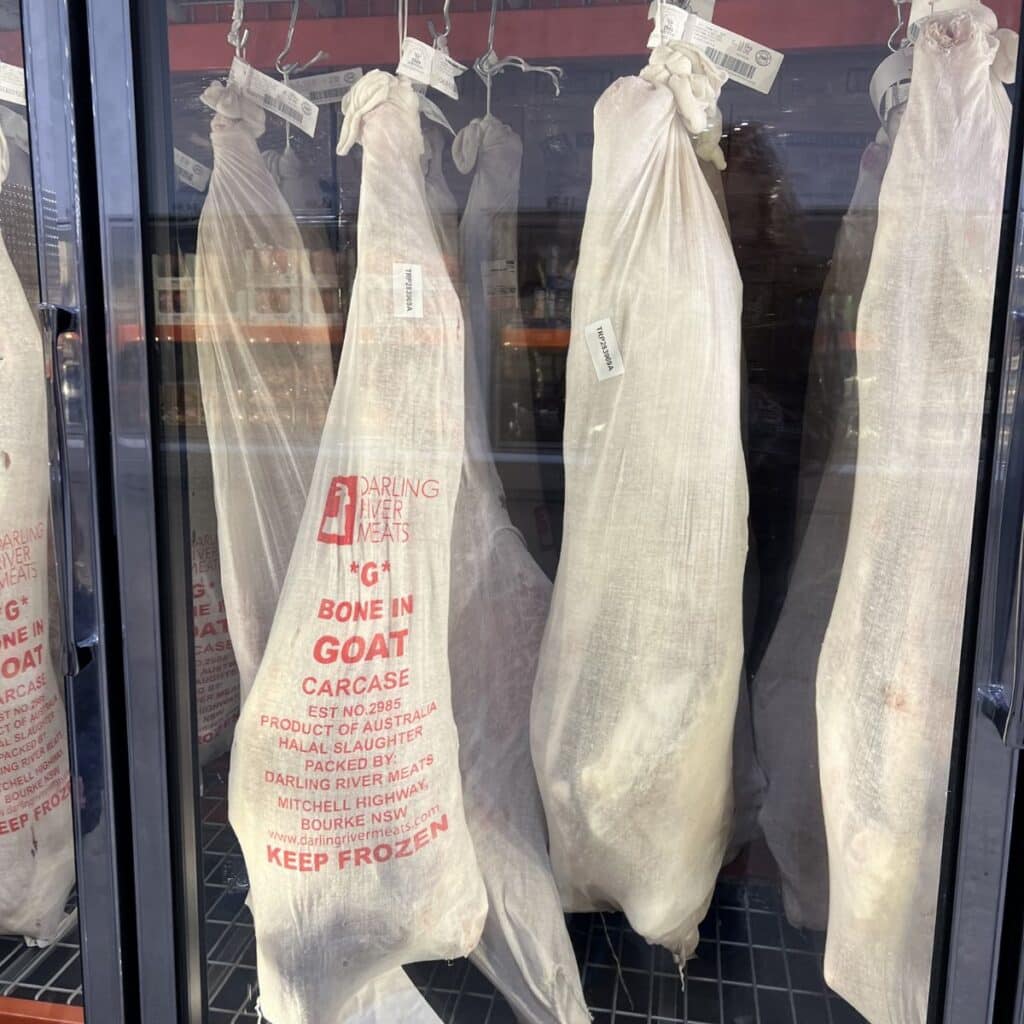
At the Minneapolis Costco Business Center, I regularly see whole frozen goats for sale. In meat industry terms, this is often referred to as a primal. However, it isn’t always available when I’ve been in the store or checked the local availability online. The cubed meat tends to be more consistently available (see the next section).
The whole goat typically weighs around 30–35 pounds. It’s frozen solid, wrapped in a burlap cotton bag, and according to the product description, broken down into six large sections. Even so, it will still need to be cut into smaller pieces before cooking or storing in your freezer at home.
The whole goat does fit in a shopping cart, but it sticks out quite a bit. Getting it home will likely require folding down seats in the back of your car or using a truck.
Since the whole goat carcasses are offered just in the Costco business centers, they are really designed for food service, such as restaurants, which have the ability to use the whole goat and break it down into smaller pieces for cooking.
However, anyone with a Costco membership can shop at the Business Centers, so families can still purchase a whole goat. It’s a good fit for those who have a large enough kitchen and supplies to break down the carcass into cubes or specific cuts of meat, as well as those who like to bulk shop and/or meal prep to keep to a family food budget.
Carcasses can be around 5 feet long (think the height of a glass freezer case door at Costco) and require a large counter or table to break it down. Also you’ll need a good set of knives, butcher style, and not just your average kitchen knives. This butchering book does a great job of illustrating how to cut a whole goat, especially if you’re interested in other retail cuts beyond just goat cubes (note this book is an affiliate link, but I use it as a reference guide with my own goat farm).
Feedback from individuals who have considered purchasing a whole goat from Costco, have brought up these questions in online forums:
- How do you break this down at home?
- Do you need to thaw it before cutting?
- What kind of knife or saw is required?
- How much freezer space will it take?
Additionally, reviews and online discussion forums like reddit have shared that seeing a full frozen carcass in a retail setting can be surprising for some.
The whole goats are also Halal, which means it was processed in a way that is approved under Islamic law.
Cubed goat meat
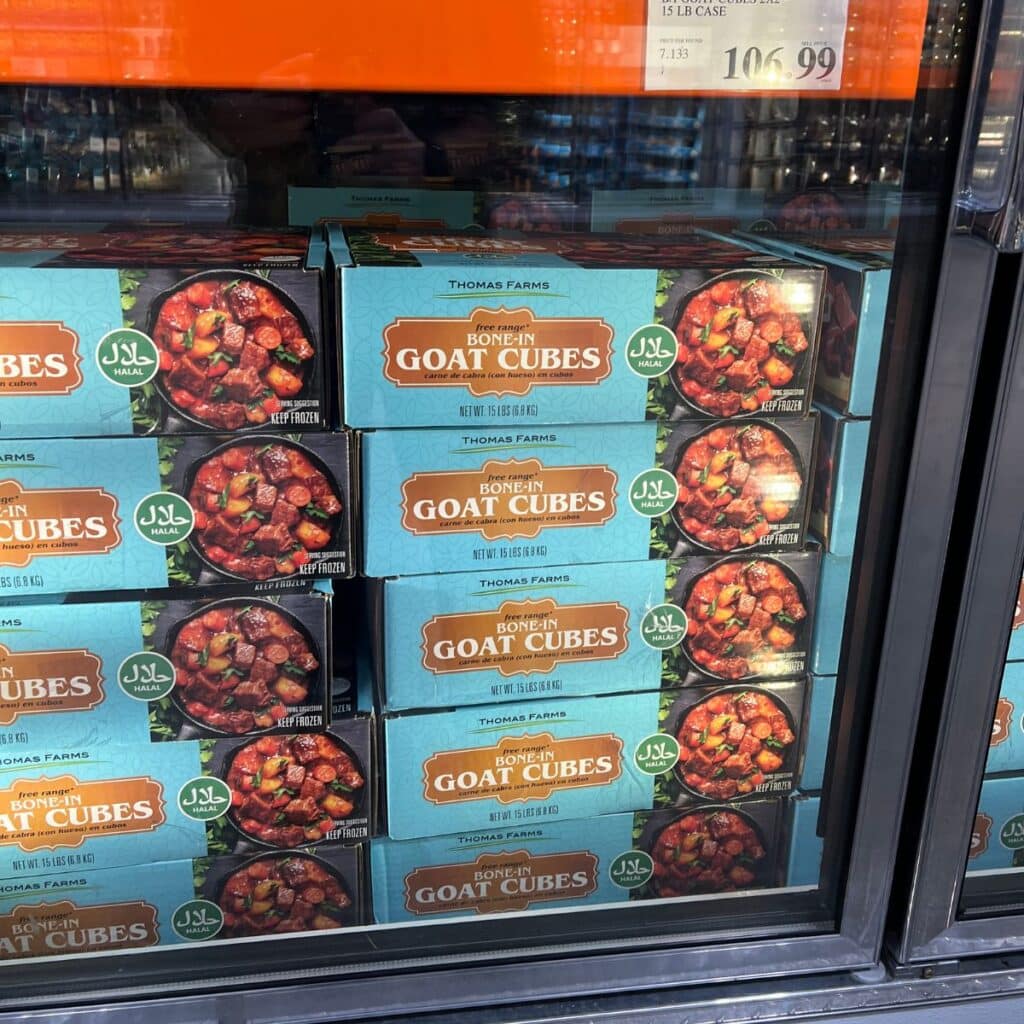
Costco also offers a 15-pound box of cubed goat meat (which is sometimes also called stew or curry cubes). Since it is in bulk, it is simply the cubed goat meat (2 inch chunks of meat with bone) in a plastic bag. It’s also labeled Halal. This type of goat meat cut is also called stew meat or curry cubes.
This is commonly available at Costco Business Centers, alongside the whole goats.
Since fall 2025, our local Minneapolis–St. Paul Costco warehouse has also carried 15-pound boxes of goat cubes in the regular freezer case under the Thomas Farms brand. I’ve never seen goat available at our “regular” Costco warehouse before, so it appears to a relatively recent addition. I’ll also note that our metro area is pretty diverse, so having goat meat at Costco wouldn’t really be out of the question.
Since this cubed goat box is the most accessible at Costco for families, not just easy to get, but easier to use over a whole goat because it is already cut up and ready to cook. Due to this fact, there is more online conversation and reviews on this particular type of goat meat. Some feedback indicates that 15 pounds can be too much for a small household unless cooking for an event. Others mention splitting a box with friends or family. For larger families or gatherings, the bulk size is seen as practical and cost-effective.
Costco goat cubes price and whole goat pricing
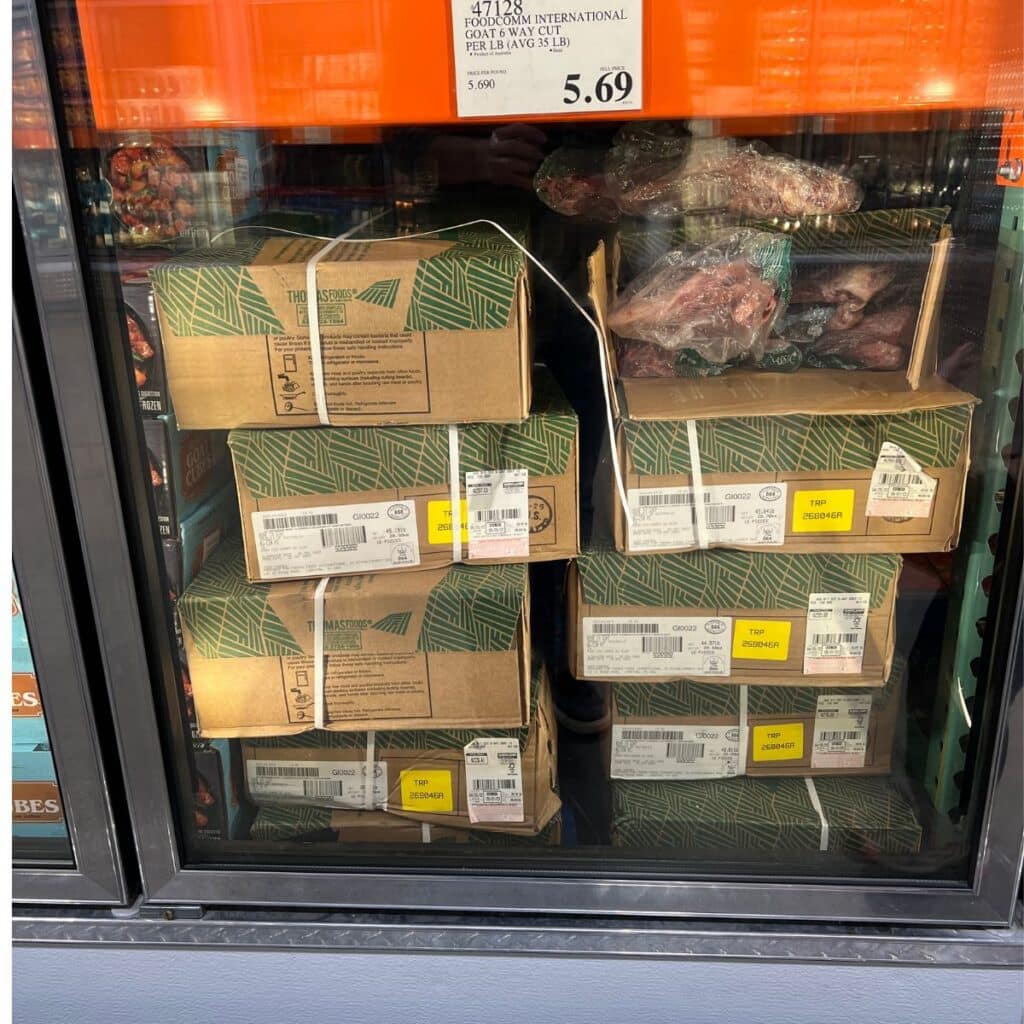
Here are the prices I’ve personally tracked at the Minneapolis Costco Business Center:
February 2023
- 15-pound box: $62.49 ($4.17/lb.)
- Whole goat: $3.29 per pound
- Approximately 30 pounds = about $98.70
February 2026
- 15-pound box: $79.99 ($5.33/lb.)
- Whole goat: $4.39 per pound
- Approximately 30 pounds = about $131.70
I’ve tracked Costco goat price data intermittently over the years and plan to monitor it more consistently going forward. Prices have increased since 2023, but they remain relatively low given what it costs to raise and process goats domestically.
In online reviews and forums many individuals frequently describe Costco goat cubes as “a steal.” Others express skepticism, asking how meat can be processed overseas and sell at this retail price.
From my perspective as someone who raises goats, the pricing is very low when you consider U.S. production and processing costs. Processing alone for a whole goat in the United States commonly runs $90–$150 per whole goat (carcass). This does not include the cost to raise the goat.
How pricing compares with goat from the U.S.
To put Costco goat price into context, it helps to look at live market benchmarks in the U.S. Live markets prices are the commodity market prices of what buyers are willing to pay for goat (as live animals).
Texas A&M has historically tracked live goat market prices in the range of $3.50-$4/lb. for the sale of a live animal at market.
Goats typically yield around 50 percent of their live weight as carcass weight for meat. This means the live weight of an animal translates to 50% meat.
Using simple math for a U.S. goat meat pricing estimate:
Whole goat:
- $3.50 live × 2 ≈ $7 per pound meat equivalent
- For a 30-pound carcass: $7 × 30 pounds = $210
- Add processing: $90 minimum
- ≈ $300 total for a 30-pound whole goat
15-pounds of goat meat (or a “half” a goat)
- For a 15-pound goat meat equivalent, just divide the whole goat pricing in half: $150
These calculations are based on commodity market pricing. They do not necessarily reflect a farmer’s full cost of production, which often is higher.
2026 Price Comparison: Imported Costco goat vs. U.S. raised goat
| Type of Goat Meat | Costco goat* | U.S. raised goat (estimated) |
|---|---|---|
| Whole goat (30 lbs.) | $131.70 | $300 |
| 15 lbs. of goat or a half goat | $79.99 | $150 |
*based on Costco Wholesale prices at the Minneapolis Business Center, February 2026
When comparing that to Costco’s roughly $131 for a 30-pound imported goat in 2026, the difference is noticeable.
You can read more about broader U.S. goat meat market trends here.
Where Costco goat meat comes from
The goat meat sold at Costco is imported from Australia. A significant portion of goat exported to the United States comes from rangeland or feral goat populations. You can read more about the Australian goat export market and feral herd system in this article.
These goats are not raised in traditional farm or ranch settings. Instead, they are caught in the wild from feral goat herds, processed in Australian meat packing plants, frozen, and exported to markets like the United States. Australia considers their wild goats to be a nuisance since they are not native to the country and has had incentive programs for ranchers to remove them from the landscape.
Australia is one of the largest exporters of goat meat globally, and the U.S. is one of its primary customers. Additional context on export volumes and trade impacts can be found in this analysis of goat meat export data and tariffs.
Costco goat meat reviews
If you’re specifically searching for Costco goat meat reviews, you’ll quickly find a wide range of opinions online.
To save you from digging through multiple platforms, I pulled feedback from:
- Costco.com product reviews
- Reddit discussions (including r/Costco and regional threads)
- Facebook halal food groups
- Instagram posts discussing Costco goat cubes
- Online forum discussions comparing Costco goat to halal butcher shops
Below is a categorized look at what people are saying about the cubed goat meat and whole goat product.
Bone and fat content
One of the most frequently discussed topics is the bone-to-meat ratio in the cubed product.
People report:
- “Mostly gristle, bone and fat”
- “Stew cubes are pieces of bone and cartilage with a little meat”
- “Pulverized bone throughout”
- “Shanks were mostly bone”
- Cuts described as uneven in size
- Some pieces considered too large for typical stew cooking
At the same time:
- Some individuals state bone-in goat is standard
- Others say this cut matches traditional curry preparation
- Several mention bone contributes flavor to stews
Tenderness and texture
Texture feedback varies widely and often depends on cooking method.
Reported experiences include:
- “Very tough and hard”
- “Doesn’t feel like goat meat”
- “Too chewy even after long marinating”
- Suggestion that meat may be from a mature animal
- Deep red color noted in some reviews
- “Needs to be cooked for quite awhile to become tender”
- Positive results after slow braising
- Pressure cooker frequently recommended
Smell and aroma
Smell upon opening the package is another recurring theme.
Comments include:
- “Very gamy smell”
- “Smells bad”
- “Strong odor when opening”
- “Discolored and had a bad smell”
- “Strong smell raw but cooks down well”
- Some questioning freshness
- Others stating goat has a natural aroma and this is normal
Reactions appear to vary depending on familiarity with goat meat.
Flavor and eating experience
Flavor feedback is divided and often tied to preparation method.
Individuals describe:
- Flavor comparable to halal market goat
- Stronger flavor than expected
- Good results in curries and stews
- Flavor improves with traditional spices
- Disappointment when cooked quickly or grilled
- Satisfaction when slow-cooked properly
You can learn more about how to slow cook goat in a slow cooker or pressure cooker here.
Cut size and preparation challenges
The physical size and format of the product comes up frequently.
Feedback includes:
- Some cubes too large for typical home cooking
- Inconsistent cube sizes
- Need to trim additional fat
- Need to cut pieces down further before cooking
- 15-pound quantity overwhelming for small households
- Families splitting boxes with relatives or friends
Cultural familiarity and expectations
Experience with goat meat strongly influences satisfaction.
People mention:
- Buying for Afghan, South Asian, Caribbean, and Middle Eastern dishes
- Comparing product to halal butcher cuts
- Comparing to kosher butcher quality
- Expecting bone-in pieces
- First-time buyers surprised by texture and preparation differences compared to beef
Other options for buying goat meat
While goat meat can be harder to find than other proteins, Costco is not the only place to purchase goat meat.
Consumers can also buy from:
- Local goat farms
- Ethnic grocery stores
One farm option to purchase meat is from Cylon Rolling Acres in Wisconsin. Disclaimer: this is our family farm. We offer meat by the retail cut, providing options beyond just cubed meat and delivery with shipping via UPS.
Key takeaways
- Costco goat cubes are sold in 15-pound Halal-labeled boxes
- Whole frozen goats are also available at Business Centers
- Most product is imported from Australia
- Pricing reflects scale and sourcing model
- Retail pricing differs significantly from U.S. live market benchmarks
Frequently asked questions about Costco goat cubes
Yes. Costco Business Centers regularly carry 15-pound boxes of Costco goat cubes. Some standard warehouses have also stocked them under the Thomas Farms brand.
As of February 2026, a 15-pound box was priced at $79.99 at the Minneapolis Costco Business Center. Prices vary by location.
Yes. Both the whole goat and the cubed product are labeled Halal in-store.
Costco goat cubes and whole carcasses are imported from Australia, with much of the supply originating from rangeland or feral goat populations.
References
- AndhraFriends.com. (n.d.). Costco Thomas Farms bone-in goat cubes discussion thread. AndhraFriends forum. Retrieved February 26, 2026, from https://www.andhrafriends.com/topic/1090969-costco-thomas-farms-bone-in-goat-cubes/
- Costco Wholesale. (n.d.). Quality Ethnic Foods Half Goat Meat Locker – 10 total packs, 15 lbs. total (Item No. 1747551) [Product page and member reviews]. Costco.com. Retrieved February 26, 2026, from https://www.costco.com/p/-/quality-ethnic-foods-half-goat-meat-locker-10-total-packs-15-lbs-total/4000186433
- Facebook. (n.d.). Discussion posts regarding Costco goat meat in halal food groups [Online discussion]. Retrieved February 26, 2026, from https://www.facebook.com
- Instagram. (n.d.). Posts and reel comments discussing Costco goat cubes [Social media posts]. Retrieved February 26, 2026, from https://www.instagram.com
- Reddit. (n.d.-a). Thomas Farms 15 lb goat cubes (Halal) discussion thread. Reddit. Retrieved February 26, 2026, from https://www.reddit.com/r/Costco/comments/1ig6l2r/thomas_farms_15lb_goat_cubes_halal/
- Reddit. (n.d.-b). “$81.99 for goat cubes is honestly ridiculous?” discussion thread. Reddit. Retrieved February 26, 2026, from https://www.reddit.com/r/Costco/comments/1q531qw/8199_for_goat_cubes_is_honestly_ridiculous/
- Svacina, L. (n.d.). Australian goat meat and what it means for the U.S. market. Grazing with Leslie. Retrieved February 26, 2026, from https://grazingwithleslie.com/marketing-meat-goats/australian-goat/
- Svacina, L. (2023–2026). Personal observations of Costco goat meat pricing in Woodbury, MN and Minneapolis–St. Paul Business Center locations [Unpublished field observations].
- Svacina, L. (2023–2026). Online pricing observations of local goat meat in Minnesota [Unpublished market observations].


LEAVE A COMMENT
Comments