




Australia’s goat meat industry continues to expand at a pace few livestock sectors can match.
The latest data, released by Meat & Livestock Australia (MLA) in May 2026, shows Australian goat meat exports reached another record in 2025, with both export volume and export value setting new highs. The industry exported 61,766 tonnes of goat meat (136.2 million pounds) worth A$464 million (approximately US$322 million), representing a 20% increase in export volume and a 28% increase in export value compared to 2024.
The U.S. dollar amount is an approximate conversion based on an exchange rate of A$1 to US$0.6949, as reported by the Reserve Bank of Australia on July 10, 2026. Exchange rates fluctuate over time. (Reserve Bank of Australia)
While Australia ships goat meat to dozens of countries around the world, the United States remains its largest customer by a considerable margin. For U.S. goat producers, marketers, and consumers, these export trends provide valuable insight into the broader goat meat market and the role imports continue to play in meeting demand.
Table of contents
- Australia remains the dominant force in global goat meat exports
- Record production drives record exports
- Where are Australia’s goats coming from?
- The United States remains Australia’s largest customer
- Why U.S. demand continues to grow
- Export growth is expanding beyond the United States
- What this means for U.S. goat farmers and ranchers
- Final thoughts
- References
Australia remains the dominant force in global goat meat exports
Australia’s influence in the global goat meat industry is difficult to overstate.
According to MLA, Australia accounts for approximately 61% of global goat meat export volume and 58% of global export value, making it the world’s leading goat meat exporter.
This position has been built over decades through a combination of an abundance of feral rangeland goats, export-focused processing infrastructure, and access to international markets. Unlike many countries where goat meat production is consumed domestically, Australia’s industry is heavily export-oriented.
As a result, developments within Australia’s goat industry often have implications well beyond its borders, particularly in markets such as the United States that rely heavily on imported goat meat.
Record production drives record exports
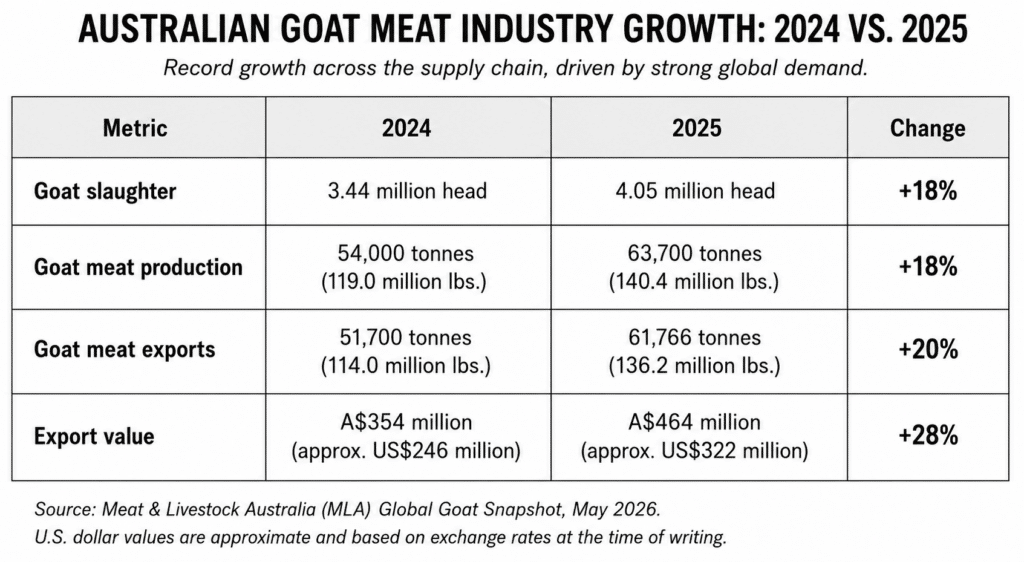
The latest MLA figures show growth throughout the supply chain. In 2025:
- Goat slaughter reached 4.05 million head, up 18% from 2024.
- Goat meat production increased to 63,700 tonnes (140.4 million pounds), up 18%.
- Exports increased to 61,766 tonnes (136.2 million pounds), up 20%.
- Export value reached A$464 million (approximately US$322 million), up 28%.
Perhaps most notable is that export value increased faster than export volume. Despite a larger supply of goat meat entering the marketplace, strong international demand helped support prices throughout the year. MLA notes that increased slaughter and production have been accompanied by relatively steady prices, suggesting global demand continues to absorb the additional product entering the market.
For an industry that has experienced rapid expansion over the past decade, maintaining strong prices alongside growing production is a noteworthy development.
Where are Australia’s goats coming from?
Much of Australia’s goat meat industry remains rooted in its depot system for collecting and marketing feral rangeland goats.
According to MLA, the vast majority of goats are supplied through Australia’s harvested rangeland system. New South Wales accounts for approximately 60% of the national supply, followed by southern Queensland.
This production model differs significantly from what many U.S. producers are familiar with. While managed goat enterprises continue to expand in Australia, a substantial portion of the industry’s supply still originates from goats harvested from extensive rangeland environments and moved through a network of collection depots before processing.
If you’re unfamiliar with Australia’s unique goat production system, I took a closer look at how feral rangeland goats move through the supply chain, from capture to export market. You can learn more in my article: Growing Australian goat meat exports to the U.S., from feral herds.
The combination of large feral goat populations, established collection and depot systems, and export-focused processing infrastructure has helped Australia maintain its position as the world’s leading exporter.
The United States remains Australia’s largest customer
While Australia exports goat meat around the world, no market is more important than the United States.
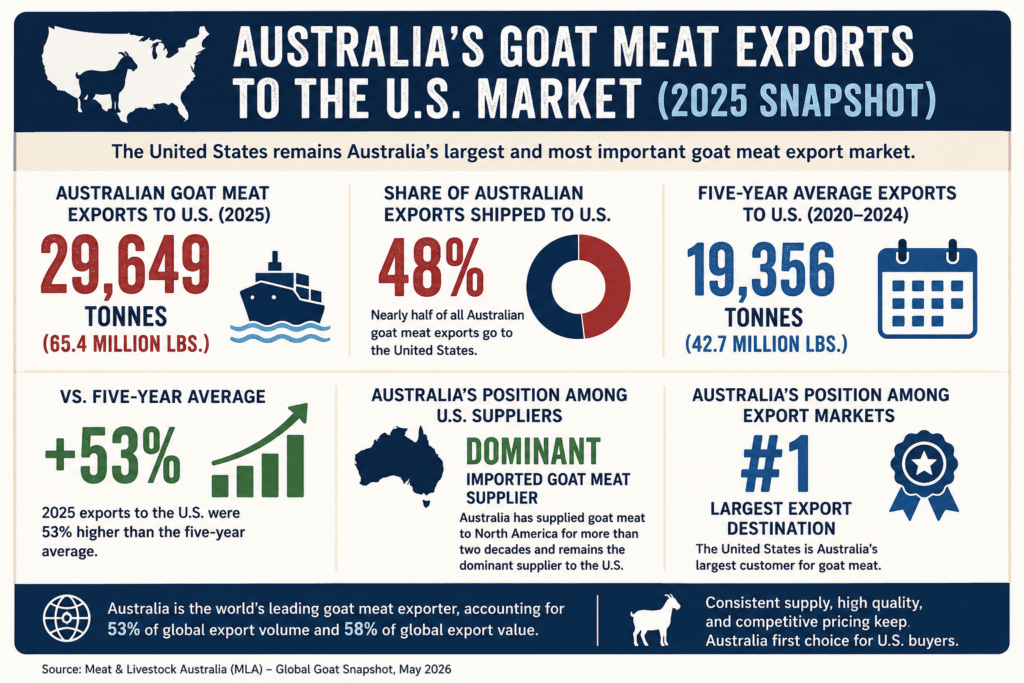
In 2025, Australia shipped 29,649 tonnes of goat meat (65.4 million pounds) to the U.S., the highest volume ever exported to a single market. Nearly half of all Australian goat meat exports were shipped to the United States.
That percentage is lower than in recent years, but it does not reflect weakening U.S. demand. Shipments to the U.S. reached a record level, while exports to other destinations also expanded. Australia is selling more goat meat to the U.S. while building a broader group of export customers.
The longer-term numbers also show the strength of the U.S. market. Australia’s 2025 export volume to the U.S. was 53% higher than its five-year average of 19,356 tonnes (42.7 million pounds). The U.S. also remained far ahead of Australia’s next-largest export markets, including South Korea and China.
Australia has supplied goat meat to North America for more than two decades and remains the dominant supplier of imported goat meat to the U.S. market. Mexico and New Zealand supply much smaller volumes. According to MLA, buyers tend to prefer Australian goat meat because of its consistent supply, quality, and competitive pricing.
Why U.S. demand continues to grow
MLA connects the continued strength of the North American market to population growth, demographic change, and evolving consumer preferences. Goat meat remains especially important among consumers with Caribbean, African, Asian, Pacific Islander and Central American cultural backgrounds. It also appears frequently in Indian, Southern Asian, Caribbean, Mexican and Middle Eastern cuisines and is consumed more often by Hindu and Muslim consumers.
At the same time, goat meat is gradually becoming available beyond ethnic grocery stores and specialty butcher shops. MLA reports that retailers including Whole Foods and Safeway have begun carrying goat meat, while the majority of imported goat meat continues to move through foodservice. Goat is appearing in curries and stews, along with more familiar formats such as burgers and sandwiches. The increasing popularity of dishes featuring goat, including birria, is also contributing to demand.
The U.S. market is therefore growing in two ways. Demand remains strong among consumers who have traditionally included goat meat in their diets, while retail and foodservice exposure is introducing it to a broader group of consumers interested in alternative proteins, health attributes and new dining experiences.
Export growth is expanding beyond the United States
Although the U.S. remains the largest destination, other markets posted strong growth as well. According to MLA:
- Exports to South Korea increased 23%.
- Exports to China increased 5%.
- Exports to Canada increased 89%.
These gains demonstrate growing global demand for goat meat and provide Australia with a broader customer base than it has historically relied upon.
A more diversified export portfolio may help reduce risk associated with economic downturns, policy changes or trade disruptions within any single country.
What this means for U.S. goat farmers and ranchers
The latest export figures reinforce a reality that has existed for many years: imported goat meat continues to play a significant role in supplying the U.S. market.
Despite growing interest in domestic goat production, U.S. demand continues to exceed domestic supply. Imports help fill that gap, and Australia remains the dominant supplier.
The record import volumes reported by MLA suggest that imported goat meat is unlikely to disappear from the U.S. marketplace anytime soon. In fact, the latest export figures highlight why proposed trade policies, tariffs and import legislation continue to receive attention from industry groups and producers. When nearly half of Australia’s goat meat exports are destined for the United States, changes to trade policy have the potential to affect both imported supply and domestic market conditions.
At the same time, growing demand for goat meat presents opportunities for domestic producers. Many U.S. goat farms continue to differentiate themselves through direct-to-consumer sales, regional marketing, ethnic and cultural market relationships, and local sourcing preferences that imported products may not be able to serve as effectively.
For producers interested in the policy side of the market, I’ve also covered the proposed Home Market Restoration Act of 2026 and recent discussions surrounding tariffs on imported goat meat, both of which could influence future trade flows and market dynamics.
Final thoughts
The latest MLA data shows Australia’s goat meat industry continues to build momentum.
Record slaughter, record production, record exports and record export value all point toward strong international demand for goat meat. While export growth is occurring across several regions, the United States remains Australia’s largest customer and imported 29,649 tonnes (65.4 million pounds) of Australian goat meat in 2025, more than ever before.
For U.S. producers, these trends provide important context about the broader goat meat marketplace. Australia’s role as the world’s leading exporter means developments there can influence pricing, supply and market conditions here at home.
As the global goat meat trade continues to evolve, Australia will likely remain one of the most important countries for U.S. producers to watch.
References
Meat & Livestock Australia. (2026). Goatmeat global snapshot: May 2026. MLA Market Information.
Reserve Bank of Australia. (2026). Exchange rates. Retrieved July 10, 2026, from the Reserve Bank of Australia.
Svacina, L. (2026). Growing Australian goat meat exports to the U.S., from feral herds. Grazing With Leslie.


LEAVE A COMMENT
Comments