



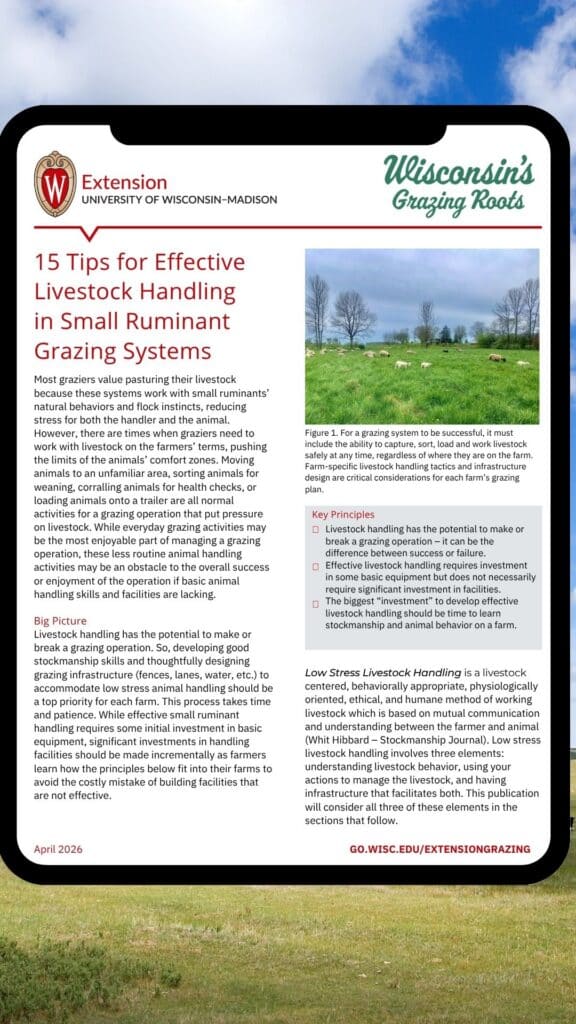
The University of Wisconsin-Madison Division of Extension recently released a new publication focused specifically on livestock handling in grazing-based sheep and goat systems: 15Tips for Effective Livestock Handling in Small Ruminant Grazing Systems.
I was asked to contribute to the publication alongside Austin Pethan of Prairie Folk Farm, who raises grass-fed sheep in eastern Wisconsin, along with Jason Cavadini, Michael Geissinger, and Laura Paine (Extension), and Adam Abel from NRCS.
When I first started rotational grazing goats more than 10 years ago on our farm, very few farmers were actually doing it. Even now, while the topic is covered with sheep, it is still rarely covered with goats. Small ruminants are often lumped together with cattle in educational resources, even though the handling, behavior, and management considerations can be very different.
Over the years, I’ve utilized rotational grazing with both sheep and goats on our farm and currently serve on the board of directors for GrassWorks, Wisconsin’s grazing organization. During that time, I’ve also seen a major increase in interest in grazing small ruminants. More farmers are utilizing grazing practices with sheep and goats, and goat grazing businesses focused on brush management have continued to grow as well.
I really appreciate that our state grazing specialists wanted input from real farmers who actively graze sheep and goats. They recognized small ruminants are not simply “little cattle” and that many livestock handling recommendations need to be approached differently when working with goats and sheep in grazing systems.
The publication covers a wide range of practical livestock handling topics including:
- Understanding sheep and goat behavior
- Flight zones and pressure
- Moving livestock calmly and efficiently
- Gathering animals from pasture
- Portable handling systems
- Temporary fencing and lanes
- Sorting and loading livestock
- Differences between sheep and goat handling
- Facility design considerations for grazing operations
The publication does a great job of not just addressing the needs of small ruminants, but also some of the differences between handling sheep and goats, recognizing they are not exactly the same either. For example, the publication discusses how sheep often move better as a tightly grouped flock, while goats are more likely to investigate, split off, climb, or react differently to confined spaces.
The resource also emphasizes that effective livestock handling is not just about expensive infrastructure. Good stockmanship, understanding animal behavior, and designing systems that work with livestock instincts are equally important.
As more farmers utilize grazing practices with sheep and goats, having species-specific educational resources like this becomes increasingly important. It’s encouraging to see more attention being given to small ruminants within grazing education and Extension programming.
You can access the new UW Extension publication here: 15 Tips for Effective Livestock Handling in Small Ruminant Grazing Systems.


LEAVE A COMMENT
Comments