




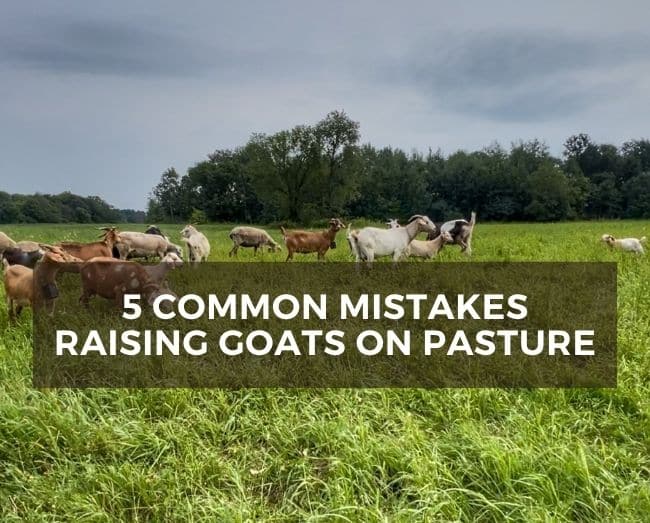
Spring grazing can feel relatively easy when forage growth is rapid, temperatures are cooler, and parasite pressure is lower. But once warmer weather hits you may begin noticing issues with overgrazed paddocks, weaker fence performance, slower pasture recovery, and increasing parasite issues with your goats. For us in the Upper Midwest (where my farm is at), it tends to be June and July.
A setup that worked well during the spring flush may suddenly start falling behind once pasture growth slows down and summer heat and humidity arrive.
In many cases, the issue is not grazing itself, but how the grazing system is being managed.
For goats, summer grazing management has a direct impact on parasite susceptibility, water intake and heat stress, and overall herd health and performance. It also influences the effectiveness of electric fencing, as well as pasture recovery, and soil cover and forage production.
The good news is most summer grazing problems can be improved with a few management adjustments.
Why summer grazing gets more difficult
Warm temperatures and humidity create ideal conditions for internal parasites, especially barber pole worm (Haemonchus contortus). Parasite larvae develop faster in moist conditions and survive longer on pasture during humid weather.
At the same time, eventually pasture growth often begins slowing down compared to spring. Many cool season forages hit a summer slump during hotter weather, especially during dry conditions. Paddocks that recovered quickly in May may suddenly need much longer rest periods in July or going into August, depending on where your farm is located.
This is also the time of year when grazing management needs to become more adaptive. Fixed schedules that worked earlier in the season often need adjustment by midsummer.
This combination creates pressure on grazing systems, often leading to overgrazed pastures, fencing issues, and goats becoming more vulnerable to stress and parasites.
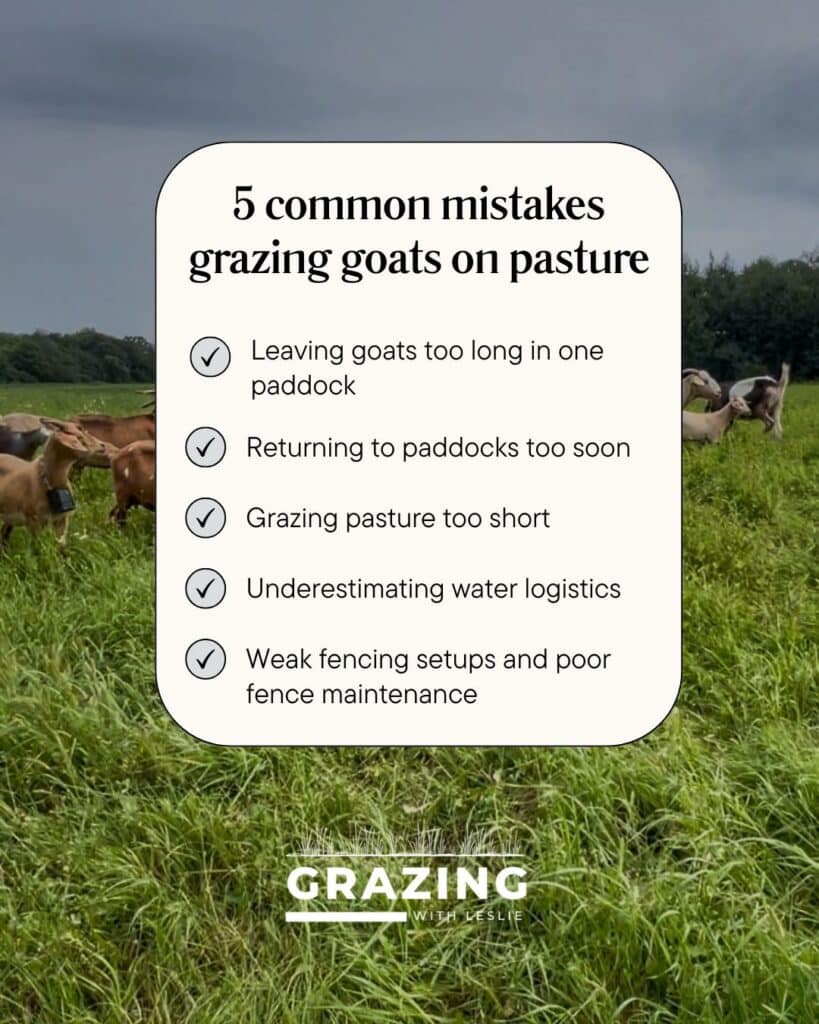
Here are the five common mistakes:
1. Leaving goats too long in one paddock
One of the most common rotational grazing mistakes is simply leaving goats in a paddock too long.
This often starts unintentionally when there still appears to be grass left, the week gets busy, or the paddock was set up larger than needed. But with goats, longer grazing periods can quickly increase problems.
As goats graze a pasture, they’re also depositing parasite eggs through their manure. In warm and moist conditions, those eggs will hatch and develop into infective larvae within several days (research shows after 4 days).
If goats are still grazing the same pasture area, they will eventually ingest the larvae, essentially reinfecting themselves.
Research and grazing recommendations commonly suggest grazing periods of only a few days, especially during heavy parasite season. On our farm, we typically move goats and sheep every 1 to 3 days depending on forage availability and the time of year.
Summer forage growth also complicates this issue. During the spring flush, goats may move quickly through abundant forage. By midsummer, regrowth slows significantly. If paddock sizes are not adjusted, goats often begin grazing lower and more selectively while staying in the paddock longer than intended.
It’s also important to note that all goats have parasites, it’s just a matter of how heavy of a load, how much they tolerate parasites (resistance), and stress that can trigger related health issues.
Some common signs goats are staying too long include:
- Staying in a paddock longer than 3 days during heavy parasite season
- Grazing pasture very short
- More selective grazing behavior
- Bare soil appearing
- Goats pushing on fences looking for fresh forage
A better approach is to base moves on forage availability and grazing impact, not just on a set schedule. The “take half, leave half” approach works well for many grazing systems. It’s still important to keep the parasite lifecycle in mind when making grazing decisions.
Portable fencing can also help make smaller paddocks and more frequent moves easier to manage.
2. Returning to paddocks too soon
The second major issue is rotating goats back into a paddock before it has had enough time to recover.
Rest periods greatly impact both pasture regrowth and parasite management.
Research referenced by the American Consortium for Small Ruminant Parasite Control notes that infective stage 3 larvae may survive on pasture for several weeks depending on weather conditions. Returning goats too early increases the chances they will ingest those larvae again.
On our farm, we generally do not return goats or sheep to a paddock before at least 45 days, and in some situations we try to extend rest periods even longer.
Weather conditions also change how grazing systems function.
During wet summers:
- Humidity helps larvae survive longer
- Heavy dew increases exposure
- Pastures may appear productive while still carrying heavy parasite pressure
During dry summers:
- Forage recovery slows dramatically
- Paddocks need longer recovery time
- Overstocked systems begin running out of grass
This is where many rotational grazing systems can start to struggle. The number or size of paddocks that worked in spring may no longer support adequate recovery time during summer.
Common causes include:
- Too few paddocks (too large)
- Overstocking
- Fixed grazing schedules
- Rotating based on calendar dates instead of forage recovery
In some situations, slowing down stocking pressure or using a sacrifice area to feed hay temporarily may be better than repeatedly overgrazing a recovering pasture. Another option may be to graze wooded or brushy areas temporarily to allow traditional pasture more recovery time.
Different forage types recover at different rates. There is a big difference between traditional pasture and a wooded or brushy area. We observe this on our own farm. Certain areas recover much faster than others depending on rainfall, shade, forage species and ground cover.
3. Grazing pasture too short
Overgrazing is not simply about the number of goats in a paddock. It is also about how long livestock remain in an area.
This becomes especially important during summer because parasite larvae tend to concentrate near the soil surface.
Research and grazing recommendations often suggest avoiding grazing below about 4 to 6 inches for goats and sheep. This is roughly the height larvae are capable of traveling up forage plants.
Additionally, once plants are grazed too low, it can start to have dramatic effects on the ability for the plant to continue to produce forage throughout the growing season. Instead, the plant shifts energy toward root recovery rather than continued forage production. This will result in much slower recovery and growth in the pasture for future use in the grazing season.
Once the pasture is short, it can also lead to more exposure of bare soil, which can reduce soil moisture retention and lead to thriving weeds.
Some signs pasture is being grazed too short include:
- Goats grazing very close to the ground
- Increased vocalization or goats “bellering” more than usual
- Goats putting more pressure on the fence, potentially getting out
- Bare patches appearing
- Slow pasture recovery
- Reduced forage availability later in summer
One of the biggest adjustments goat owners can make is moving livestock sooner, even if it feels like some forage remains unused. Leaving more residual behind generally improves future regrowth and pasture resiliency.
4. Underestimating water logistics
As temperatures rise, water intake increases significantly, especially for lactating does. If water access is limited or inconvenient, goats often change their grazing behavior and spend more time concentrated around water and shade areas.
These heavy traffic areas can quickly become muddy, overgrazed, heavily contaminated with manure, and higher-risk areas for parasite exposure.
Water problems can also reduce overall grazing efficiency. Heat-stressed or dehydrated goats may graze less evenly and spend less time utilizing available forage.
Common summer water issues include tanks running empty, water too far from paddocks, poor flow rates, mud buildup around tanks, not moving portable water systems frequently enough, and algae buildup.
Portable water systems can make a major difference in rotational grazing management. On our farm, we use a seasonal waterline in our pastures and portable water trailers for grazing off grid. Both allow us to move water access with the herd rather than forcing goats to travel long distances back to a permanent source.
To minimize labor moving water, another option is a wagon-wheel style paddock system, where water is located in the center and paddocks rotate around it. The area around the water will still get beat up, but new forage/paddocks are always fairly close for goats to graze while still easily accessing water.
5. Weak fencing setups that disrupt grazing rotations
Fence failures often create a chain reaction of grazing problems. The most obvious issue is simply keeping goats where they are supposed to be.
First, training your goats to respect electric fence is very important. On our farm, we retrain new kids every spring and refresh older livestock on electric fence before the main grazing season begins. Properly trained goats respect electric fence much more consistently.
Fencing challenges also often arise from vegetation growth, including tall grass, weeds, and brush that ground out fences. This can dramatically reduce voltage and make electric fences ineffective very fast. One solution is maintaining vegetation around permanent fence lines by mowing or spraying once or twice during the season, depending on growth and where issues arise.
When vegetation becomes an issue with portable fencing, such as poly wire, electronet or SmartFence, it’s because the fence was left in an area too long or the site was not prepped properly. Portable fence is temporary and designed to be moved regularly. If vegetation is growing up through the fence, it has likely been left in that location too long.
Site prep for setting up a portable fence can lead to issues when tall grass or brush is still standing. With grass, the solution is fairly simple, mat down the grass with your feet or even a UTV/ATV path, or use a mower. Brush is more work, but definitely worth the time to use a brush hog or handheld brush mower to clear a path.
If you’re not sure where the issue is, sometimes just using a fence checker (or fault finder) that gives you directional indicators, can help with narrowing down the problem areas.
Other common electric fencing issues may be from the energizer being left off, not having enough grounding rods, or an undersized energizer.
Key takeaways
- Summer grazing management often requires different strategies than spring grazing
- Leaving goats too long in a paddock can increase parasite exposure and pasture stress
- Longer rest periods help both forage recovery and parasite management
- Grazing pasture too short weakens plant recovery and increases larvae exposure
- Water systems directly affect grazing behavior and pasture pressure
- Fence maintenance plays a major role in successful grazing rotations
- Flexible grazing systems usually perform better than rigid schedules during summer conditions
References
- Andries, K. (2013). Summer parasite management strategies in goats. American Consortium for Small Ruminant Parasite Control.
- Crider, J.F. (1955). Root growth stoppage resulting from defoliation of grass. USDA Technical Bulletin 1102.
- Dietz, H. (1989). Grass, the Stockman’s Crop. USDA.
- Poudel, S. (2024). Pasture management techniques to reduce parasite loads in small ruminants. American Consortium for Small Ruminant Parasite Control.
- Zajac, A. (2013). Biology of parasites. Proceedings of the American Consortium for Small Ruminant Parasite Control Conference.


LEAVE A COMMENT
Comments