



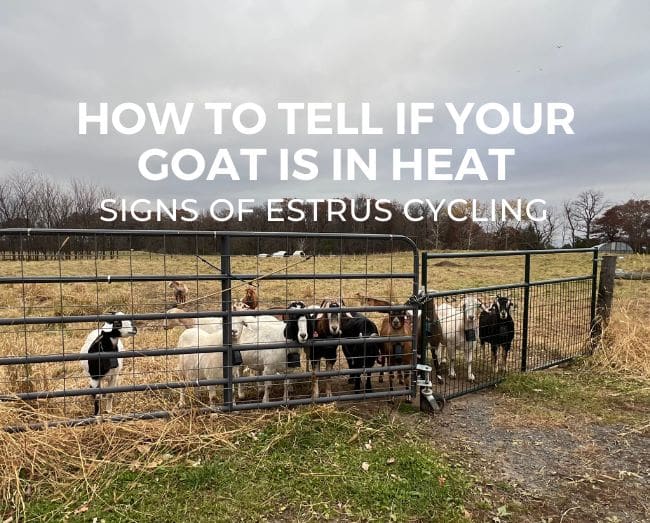
Understanding when your goats are in heat is one of the most important parts of managing a successful breeding season. Recognizing the signs early helps you plan breeding pairings, improve conception rates, and make the most of your breeding window.
On our farm, I start watching for behavior changes as the days get shorter (less light) and fall begins to set in. For context, we’re in the Upper Midwest in Wisconsin. I’ll often hear more vocalizing across the pasture, tails waving in the air, and a general restlessness among the herd.
If you’ve ever wondered exactly what’s going on during this time, here’s what to look for and how to manage it. I also include a video of does in heat on our farm for a visualization of these signs, which I know would have been helpful to see when I was first raising goats.
Table of contents
Understanding the goat heat cycle
The goat heat cycle, also known as the estrus cycle, typically lasts 18 to 22 days. Estrus is the period when a doe is receptive to breeding, and it usually lasts 24 to 48 hours.
Hormones drive these cycles. Estrogen rises during estrus, causing behavioral and physical changes, while progesterone takes over afterward to support potential pregnancy. Light exposure, or photoperiod, also plays a big role. As daylight shortens in late summer and fall, does (female goats) start cycling more regularly, which is why many goat breeds are seasonal breeders.
Some breeds, especially tropical or dairy types, may cycle year-round, but meat breeds raised in temperate climates usually show their strongest heats from late summer through early winter (Stewart, 2024).
If you’re planning for breeding, it’s a good time to review your herd’s readiness. I share more details on how to prepare in my article on breeding goats.
When do goats go into heat?
Most does begin showing heat cycles when day length decreases, usually between August and January, depending on the geographical location of your farm. If your farm is farther south or in a warmer climate (closer in latitude to the equator), you may see heat cycles earlier, experience a longer breeding season, or even year-round cycling.
Heat or estrus cycles may be irregular depending on your farm’s location outside of this typical day-length window.
Shorter daylight, cooler weather, and the scent or presence of a buck all help trigger these cycles. Even if a buck isn’t directly with the herd, his scent alone can spark activity, especially if you use the buck effect. The strategy is to keep the buck nearby, then introduce him suddenly to stimulate estrus.
Every goat will show different signs or degrees of “symptoms” when coming into heat, and this is normal. Some does have strong cycles, while others display weaker signs or even skip cycles if environmental or nutritional conditions aren’t ideal.
For more background on how breeding timing fits into the bigger picture, see my article on managing the goat breeding season.
Signs of heat in goats
Knowing what does in heat look and act like makes all the difference. Some signs are easy to spot; others can be subtle.
Behavioral signs include:
- Frequent tail wagging or “flagging”
- Loud bleating, calling, or even crying sounds
- Pacing the fence line or acting restless
- Mounting other does or letting them mount her
- Behavior mimicking that of a buck in rut: sniffing other does, curling their lips (flehmen response), or blubbering
- Rubbing against objects or the fence
- Reduced appetite
- Increased affection toward you
Physical signs include:
- A swollen, reddened vulva
- Clear or cloudy discharge
- Frequent urination
Video: Signs of Does in Heat
You can see these behaviors in action on my farm in my video below. From experience, I know it can be helpful to actually see the behavior.
When external factors delay or suppress heat
If your goat isn’t coming into heat, there are a few common reasons why. Heat cycles are closely tied to overall health and nutrition.
- Body condition: Does that are underweight, overconditioned, or recovering from heavy lactation (still have kids nursing, or were recently weaned) may not cycle regularly.
- Nutrition: Low energy, protein, or mineral imbalances, especially deficiencies in copper or selenium, can disrupt hormone balance.
- Parasites or disease: Internal parasites or illness can stress the body enough to delay or suppress heat.
- Postpartum timing: Some does take longer to return to normal cycling after kidding.
- Environmental factors: Extreme heat, poor ventilation, or overcrowding can increase stress and affect reproductive function.
- Pasture quality: In regenerative grazing systems, seasonal forage changes also play a role. When pastures mature or dry out, energy and protein levels drop, which can delay heats.
On our farm, as we approach breeding season, our pasture availability is typically winding down. Keeping that in mind, I’ve taken a few approaches to help address the potential changes in the goats’ feed quality.
If possible, I’ll set aside one of our pastures or a portion of a hayfield for grazing during the month before and during breeding season. This means we aren’t grazing it in late summer or early fall. That way, we’re feeding our does high-quality forage as they approach breeding season, which supports their ability to come into heat.
The second option is supplemental feed. If pasture quality and availability are dropping, we’ll start feeding our higher-quality hay to make sure they’re getting the nutrition they need.
In both of these instances, we make sure to provide the herd access to their mineral mix along with a supplement tub. In particular, I’m a big fan of Purina’s Goat Mineral and their purple Accuration tubs for sheep and goats. Both are typically available through your local farm co-op or can be ordered for pickup at your local Tractor Supply.
Note: the links above are affiliate links, which I only share products I’ve actually used on my farm.
Tracking and managing heat cycles
Recording your goat heat cycle data makes breeding easier to track. I keep notes in a Google Doc (you can use a notebook, too) with dates and behavior or signs of heat cycles.
Since my herd is large, I tend to keep general notes based on the herd broadly as we approach breeding season. Because we keep the buck in with the does for two cycles, I take more detailed notes on who I see coming into heat in later cycles to better understand which goats might be cycling later or on a different timeline.
If you’re able to detect heat cycles beforehand, it can be helpful to know when to roughly expect breeding once you put a buck in with the group of does.
To synchronize naturally, many producers use the buck effect, as mentioned earlier. It involves isolating the buck for several weeks, then reintroducing him to the herd. The sudden exposure to his scent triggers estrus in most does within two to five days (Merck, 2024).
If you’re preparing for breeding, here’s my list of breeding supplies I keep on hand before the season starts.
Timing breeding for the best results
Once you see clear signs of standing heat, when the doe willingly stands for the buck, timing becomes important. The optimal breeding window is typically 12–48 hours after the onset of heat, since ovulation happens near the end of estrus.
If you’re breeding naturally with a buck, which is most common with goat herds in the U.S., keeping the buck in with the does for the estrus cycle (18–22 days) is a good practice since goats in your herd may vary slightly in when they come into heat. This way, you’ll be most likely to catch them all within the same time frame.
For AI (artificial insemination), work with your veterinarian or breeding technician to pinpoint the right moment. Often this involves synchronizing your does to bring them into heat artificially.
Good timing not only boosts conception rates but also helps group kiddings (births of baby goats), which simplifies management later in the year.
Frequently Asked Questions (FAQs)
Most does start cycling when day length shortens, typically from August through January in temperate regions, though some breeds in warmer climates may cycle year-round.
A doe’s heat, or estrus, usually lasts 24 to 48 hours, with the most fertile period toward the end of that window.
Goats generally come into heat every 18 to 22 days during the breeding season until they’re bred.
Common signs include tail wagging, loud bleating, restlessness, mounting other goats, and clear discharge; some does may also act more affectionate or mimic buck behavior.
References
- Stewart, J. (2024). Puberty and Estrus in Goats. Merck Veterinary Manual.
- Stewart, J. (2024). Synchronization of Estrus in Goats. Merck Veterinary Manual.
Related blog articles
- Preparing for breeding season: An overview
- Breeding season supplies and gear
- Transitioning goats from summer pasture to fall grazing and supplemental feeding


LEAVE A COMMENT
Comments