


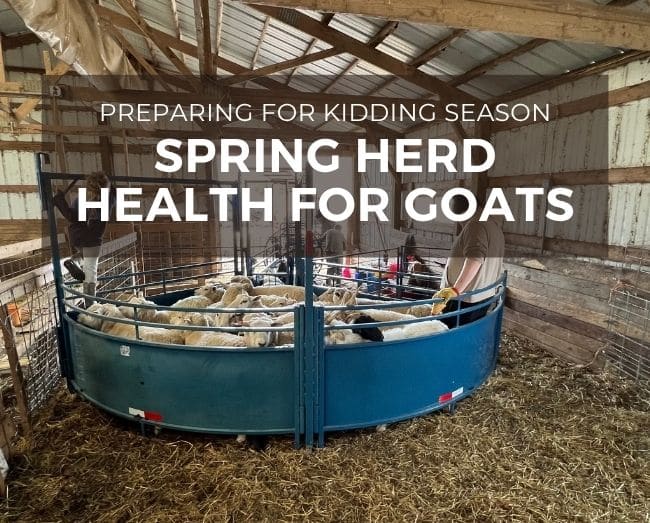
Spring herd health work is one of the most important checkpoints we have on our farm each year. While the focus is on preparing does for kidding season, it’s also a practical time to handle the entire herd and take care of anything that needs attention.
On our farm, Cylon Rolling Acres, we often refer to this as our spring herd health day. We plan this work for about 30 days before kidding. That timing allows us to get vaccinations in, evaluate each animal, and address any health concerns before kidding begins. It also sets the herd up for grazing season, which follows not long after.
Table of contents
- Why we do spring herd health work
- When to schedule your herd health day
- What to evaluate during herd health checks
- Spring goat herd health checklist
- Logistics of spring herd work day
- Handling considerations for late gestation does
- Record keeping during herd health
- Sorting and management decisions
- Supplies we use for spring herd health
- Common mistakes to avoid
- Key takeaways
- Related resources
- FAQ: Preparing for spring herd health and kidding
Why we do spring herd health work
This herd health day is centered around preparing does for kidding season, but it serves a broader purpose across the whole herd.
First, we’re able to get CDT vaccinations done in the right time window so does can pass immunity on to their kids. It also allows us to catch any issues with body condition, parasites, or overall health before the added stress of kidding.
Since we are already handling the herd, we use this time to take care of as many herd health tasks as possible.
There’s also a seasonal component to this. Spring and kidding are natural stress periods. As does go through late gestation and into labor, they can be more susceptible to parasite challenges. All goats carry some level of parasite load, but stressors like kidding can increase susceptibility and allow those parasites to become more of an issue.
When to schedule your herd health day
We plan our herd health day for about 30 days before kidding starts.
This lines up with CDT vaccination timing, which is typically recommended about 3 to 4 weeks before kidding. It also gives us time to respond if we find anything that needs attention, whether that’s body condition, hoof issues, or parasite concerns.
Weather and handling conditions also play a role. Early spring can be unpredictable, so we plan ahead and try to set up our working chute area inside the barn so we are out of any rain or wind. If temperatures are lower, being inside also makes the process more comfortable.
Since this is a full-day effort for us, we also plan the logistics ahead of time. That includes lining up help, getting supplies ready, and making sure our chute and pens are set up.
What to evaluate during herd health checks
Our evaluation process during spring herd health is the same approach we use in the fall when preparing for breeding. We are looking at each animal individually and making decisions based on those observations.
As goats move through the chute, we’re evaluating several key areas:
Body condition
Body condition is a key focus. Similar to breeding season, we are aiming for goats to be in a solid, moderate condition going into kidding, generally around a 3 to 3.5 body condition score.
We are looking for goats that are too thin or over-conditioned and making note of those animals for follow-up or monitoring.
FAMACHA
We use FAMACHA scoring to assess parasite load, specifically looking for signs of barber pole worm. This is one of the indicaters we use to guide deworming decisions as animals move through the chute. We also take body condition and overall health into consideration as well.
Overall health and appearance
Along with body condition, we are evaluating overall health, including coat condition and appearance of legs, body, and udder (and scrotum for bucks). Additionally, we’re watching for anything concerning, such as scours, skin conditions, coughing, lethargy, and so on.
Hoof condition
This is assessed while we’re trimming hooves. If there are any issues, such as hoof separation or rot, we’re treating it appropriately. Also, if any goats have excessive hoof growth or irregular growth, we make note of it in their records. These aren’t particularly desirable traits to carry into future generations of the herd.
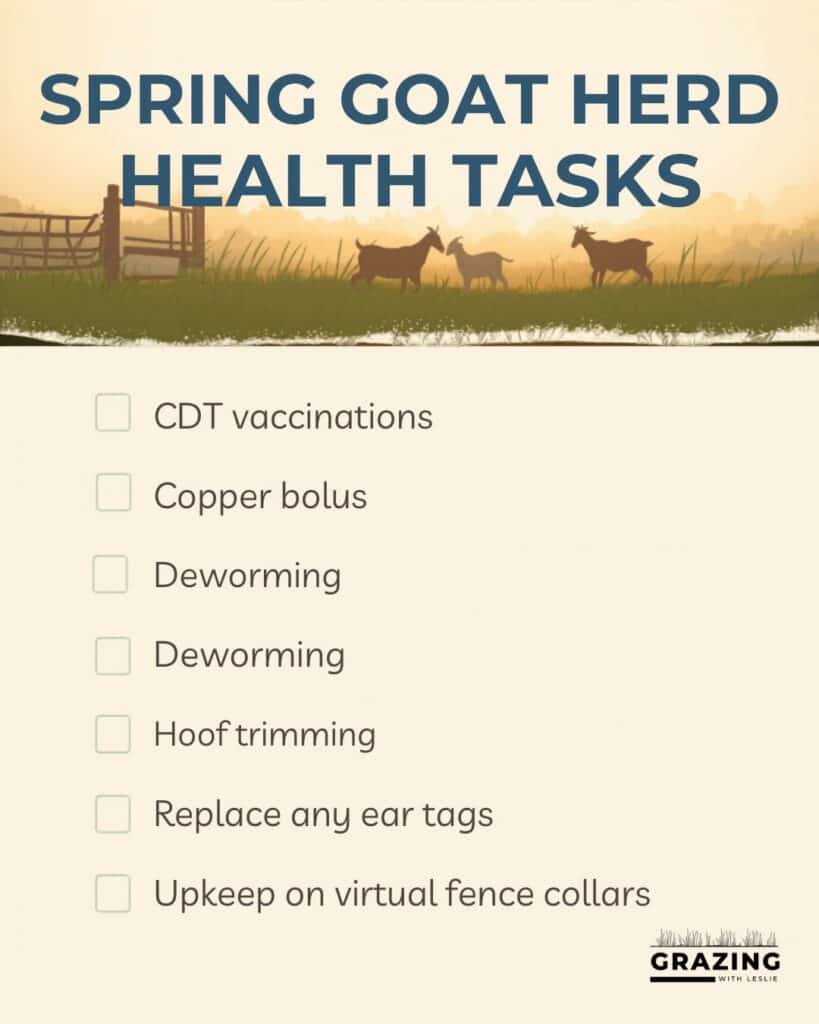
Spring goat herd health checklist
On our spring herd work day, we’re running our goats through our working chute, which makes the whole process more efficient, allowing us to handle animals safely in a low-stress setting. It also streamlines the process for everything we need to get done.
Here are the tasks that we do:
CDT vaccinations
We give CDT vaccinations about 3 to 4 weeks before kidding. This allows does to build immunity and pass it on to their kids through colostrum.
Copper bolus
We also give a copper bolus at this time. Since we run goats and sheep together, we feed a sheep mineral, which is very low in copper. Goats need more copper than sheep, so this step helps supplement what they are not getting in their mineral. Copper boluses also have research behind them in helping reduce barber pole worm issues.
Deworming
Deworming is done if needed. Similar to our fall herd health work, we base deworming decisions on FAMACHA, body condition, and what we are seeing with each animal. We do not deworm the entire herd.
When we do deworm, we will often use dewormers from two or three different classes. This is based on research showing improved effectiveness when combining classes rather than relying on a single product.
This is what works in our system, but approaches may vary depending on your herd and management style.
Hoof trimming
Hoof trimming is easier to get done before does are heavier late in pregnancy, and it helps prevent mobility issues in general, but especially when we get into grazing season.
Replace any ear tags
Since we already have animals in the chute, we also take care of ear tags if any have lost tags. It is much easier to do it at this time.
Upkeep on virtual fence collars
We also use this opportunity to maintain our virtual fence collars. That includes cleaning them, replacing batteries, and refitting them as needed.
Logistics of spring herd work day
We run our entire herd of goats and sheep through the chute on this day, and it typically takes a full day to get everything done.
Most of the preparation happens in the week leading up to it. We set up our working chute and pens, organize all of our veterinary and herd health supplies, and get everything ready so the day runs smoothly. I also prepare meals ahead of time so we can take a break and eat without slowing things down too much.
We usually have 3 to 4 people helping us. We do not have employees, so this is a day when we bring in help to get everything done efficiently.
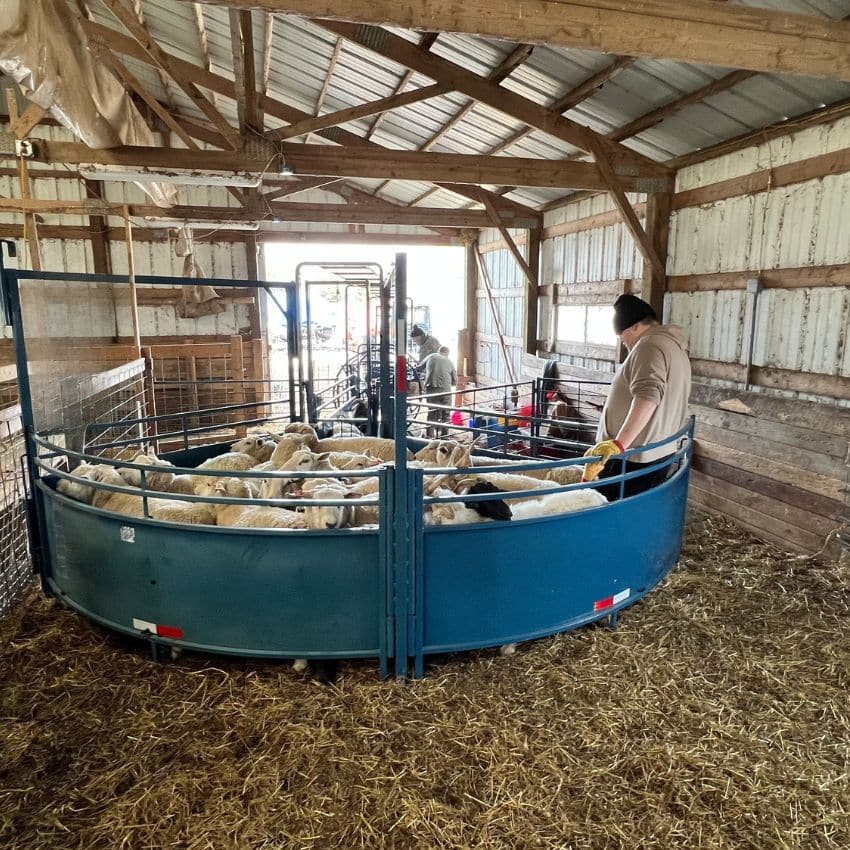
Our workflow is set up around our chute system in the barn. We have 1 to 2 people moving goats and sheep into a holding pen and pushing them into the tub. From there, animals move into an alleyway where most of the herd work happens.
In that alleyway, we have two people handling deworming, copper bolus, vaccinations, and virtual fence collars.
We also have a hoof trimmer working through the animals as they come through. He is trimming their hooves in our tilt table (or sometimes called a spin doctor).
My role is to manage the whole process and make any decisions on animal needs. I am taking herd health notes, replacing ear tags if needed, changing out batteries, cleaning collars, making final calls on deworming decisions, and assisting wherever needed.
This setup works for our farm, but it may look different depending on your chute system and the help you have available.
Handling considerations for late gestation does
Since this work is done about 30 days before kidding, it is important to be mindful of stress on late gestation does.
We focus on keeping things moving efficiently so animals are not standing in the chute longer than necessary. We are also cognizant of how we’re moving them through the tub and on the tilt table for hoof trimming. While we always keep our animals’ best interests in mind, we take extra care when they are getting closer to kidding.
There is always a balance between getting necessary herd work done and minimizing stress as does get closer to kidding.
Record keeping during herd health
We use this time to keep records on the herd as animals come through. That includes tracking treatments given, making notes on body condition, behavior, or health concerns, and identifying goats that may be candidates for culling.
These notes help guide future herd decisions and give us a record to look back on later.
Sorting and management decisions
As we are working animals through the chute, we are also making note of anything that needs follow-up.
If we see does with poor body condition, coat issues, or other health concerns, we make note of it. Since most of these does are bred, they typically remain with the main group, but we continue to monitor them. I will often mark them with paint so it’s easy to revisit them if they’re with the main group.
If there are animals that need additional hoof care, we may sort them into a separate pen so they are easier to re-treat.
This can also be a natural time for some farms to sort off different groups, such as replacement does, market animals, or bucks, if they are still running with the herd.
Supplies we use for spring herd health
- Hoof trimmers
- CDT vaccines
- Syringes and needles
- Copper bolus and bolus gun
- Dewormer (if needed)
- Ear tags and tagger
- Record-keeping tools
Common mistakes to avoid
- Waiting too close to kidding
- Missing the CDT timing window
- Skipping individual evaluations of each animal
- Over-deworming instead of using a targeted approach
- Not addressing hoof issues before turnout
- Splitting this work into multiple handling events instead of being efficient
Key takeaways
- Plan herd health work about 30 days before kidding
- Use one handling event to complete multiple tasks
- Focus on body condition, parasite management, and hoof health
- Set both kidding and grazing season up for success
FAQ: Preparing for spring herd health and kidding
CDT vaccines are typically given about 3 to 4 weeks before kidding. This timing allows the doe to build immunity and pass it on to her kids through colostrum.
Not necessarily. Deworming should be based on FAMACHA scores, body condition, and other signs of parasite load. Not every goat will need to be treated before kidding, even during this time of increased stress.
Kidding is a natural stress period, and stress can increase a goat’s susceptibility to parasites. While all goats carry some parasite load, managing it before kidding can help reduce issues during late gestation and early lactation.
Yes. Trimming hooves about a month before kidding is often easier and more practical than waiting until does are heavier late in pregnancy. It also helps prevent mobility issues during kidding and when goats return to pasture.
Not necessarily, but it is often more efficient. Handling the whole herd at one time allows you to complete multiple herd health tasks in a single event, rather than stressing animals multiple times throughout the season.
Focus on body condition, parasite load (FAMACHA), overall health and behavior, and hoof condition. The goal is to identify any issues before kidding so they can be addressed early.
About 30 days before kidding is a good target. This gives you time to complete vaccinations, evaluate your herd, and respond to any issues before kidding begins.
Yes, but it should be done carefully. Keep handling efficient, minimize stress, and avoid keeping does in the chute longer than necessary. You can always consult your veterinarian with more questions.
Ideally, goats should be in a moderate body condition going into kidding, generally around a 3 to 3.5 on the body condition score scale. Goats that are too thin may struggle during late gestation and early lactation, while over-conditioned goats can also have complications.
If you miss the ideal window, it is still better to vaccinate than to skip it entirely. Your does still need their annual booster. However, vaccinating closer to kidding may reduce how much immunity is passed to the kids through colostrum.


LEAVE A COMMENT
Comments