



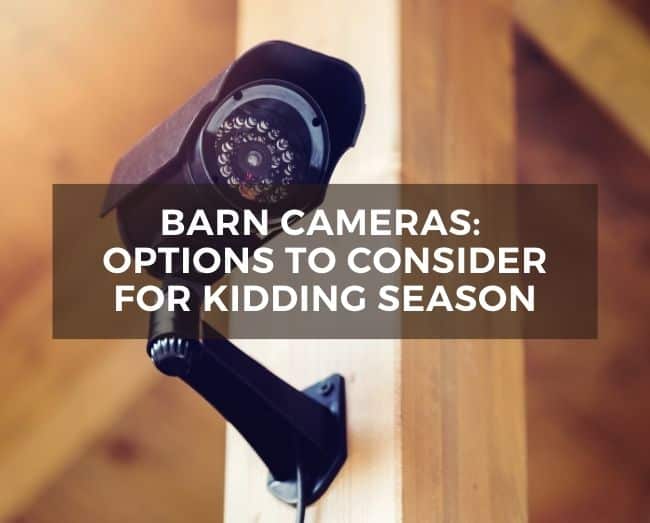
Barn cameras can save time, sleep, and livestock during kidding, lambing, and calving season. For many farmers and ranchers, these cameras are less about security and more about monitoring animals during birth without needing to be in the barn around the clock.
We’ve used several different barn camera setups in our metal pole barn during kidding season. It took trial and error to find what worked with our building and connectivity limitations. Once we had a stable system in place, it reduced unnecessary checks and made monitoring more efficient.
Table of contents
- Benefits for using barn cameras with calving and kidding
- Barn cameras vs home security cameras
- Different types of barn cameras for livestock operations
- Barn cameras without WiFi or internet
- Long range wireless barn cameras: what to expect
- Durability and environmental challenges
- Subscription considerations for barn cameras
- List: Barn cameras options
- Real-world connectivity troubleshooting
- Frequently asked questions about barn cameras
- Barn camera and connectivity terminology glossary
Benefits for using barn cameras with calving and kidding
- Reduce overnight barn checks
- Respond faster to active labor
- Monitor high-risk animals without disturbing them
- Save time and labor during peak season
- Catch early signs of complications
Many farmers report that barn cameras help them catch births they otherwise would have missed, especially overnight or during extreme weather.
Barn cameras vs home security cameras
Not all outdoor cameras are built for livestock barns. Barn conditions include:
- Dust and bedding particles
- Spiders building webs over lenses
- Humidity and ammonia exposure
- Large temperature swings
- Potentially extreme cold temperatures in northern climates
- Livestock contact with mounted equipment
Consumer-grade home cameras may work temporarily, but some may not work with long-term use in livestock barns.
Different types of barn cameras for livestock operations
Cameras operate differently depending on the operating system. This section will cover the basic functionality of different types of cameras. The type of camera best suited for your livestock barn may be influenced by how far your barn is from your house, the barn material or even if your barn is not located by your residence.
WiFi barn cameras
WiFi barn cameras work best when the barn has reliable internet access. They allow livestreaming to a phone or computer.
We extended WiFi to our metal barn using mesh routers. Once coverage stabilized, we used Google Nest cameras during kidding season. We did not rely on motion alerts and instead checked the feed at set intervals.
Important clarification: many people searching for wireless barn cameras assume they work without internet. Most WiFi models still require a stable internet connection to livestream remotely.
These wifi cameras require a router and internet connection.
- Google Nest Cam
- Arlo Pro 5
- Wyze Cam v3
- Blink Outdoor
- River Wind (operated by Barn Watcher) (typically WiFi-based systems)
- Some Barn Owl models (WiFi versions)
Best for: barns with reliable internet
Cellular barn cameras
Cellular barn cameras do not require WiFi, but they do require strong cellular service and a data plan.
These are often chosen for remote calving barns or leased ground without internet access. Some cell-connected wildlife cameras can stream video, but performance depends entirely on signal strength.
Metal barns frequently weaken cell reception, even if coverage appears strong outside the building.
These use a SIM card and mobile data plan.
- Anywhere Cam
- Reolink Go PT Plus
- Some Barn Owl cellular models
Best for: remote barns, leased ground, or no internet access.
Closed-loop camera systems
These systems connect to a dedicated monitor inside the house and do not rely on cloud access.
Early on, we used a closed-loop system with its own monitor. It worked reasonably well, but connectivity challenges led us to run CAT6 Ethernet cable from the house to the barn for greater reliability.
Hardwired Ethernet remains one of the most stable long-distance solutions between house and barn.
Local monitor-based systems that do not require cloud access include
- Generic wireless closed-circuit systems
- Some Riverwind barn camera configurations may be installed as hardwired or locally monitored systems, depending on setup
Best for: barns near the house where the internet is unreliable but a direct monitor feed is acceptable.
Trail cameras
Trail cameras are sometimes used temporarily during lambing or calving season. Most send clips or still images rather than livestreaming video.
Cellular trail cameras may stream if signal allows, but they are not typically designed for continuous monitoring.
Baby monitors
If your barn is within range of your home, an audio monitor can be sufficient. During lambing and kidding especially, sound often provides the earliest sign that labor is progressing.
Here are two long-range audio only baby monitor options that may work for kidding:
- VTech audio baby monitor: This is a long range monitor for 1,000 feet. I actually used this monitor when my children were young to do chores while they napped. I didn’t use it for kidding season, but it would be a worthy option to try out.
- Motorola nursery audio baby monitor: This is a newer option with a long range rating of 1,500 feet. It also is waterproof as well.
Barn cameras without WiFi or internet
Many farmers search specifically for barn cameras without WiFi or barn cameras with no internet.
There are several options available. From the types of cameras listed earlier, these are the best options that do not require wifi or internet access:
- Cellular cameras: often the simplest solution when internet cannot be extended to the barn.
- Closed-loop monitor systems: These systems operate independently of internet access and connect directly to a monitor in the home. Riverwind does offer an option without any internet.
- Audio-only monitors (baby monitor)
It is important to note that “wireless” does not automatically mean “no internet required.” Many wireless barn cameras still depend on WiFi to stream remotely. Or, cameras may use an internal wifi system for cameras to communicate with the system hub, but not actually use “internet.” It simply using wifi as a communications mode.
Long range wireless barn cameras: what to expect
Many farmers search for long range wireless barn cameras hoping to span large distances between house and barn.
Real-world limitations include:
- Router range
- Interference from trees and buildings
- Metal siding reducing signal strength
- Distance beyond line-of-sight
Using point-to-point wireless bridge systems or mesh systems can extend coverage, but they do not eliminate interference. In many cases, running Ethernet cable between buildings could provide more consistent performance.
Durability and environmental challenges
Here are some common challenges farmers and ranchers sometimes face with their barn cameras.
These factors may be worth considering when you’re looking at the right system for your livestock barn for calving, kidding or lambing:
- Spiders webs over infrared lights or camera lenses
- Dust reducing video clarity
- Battery drain in freezing temperatures
- Solar panels underperforming in winter
Some of these issues can be solved by:
- Cleaning camera lenses before calving, kidding and lambing season begins
- Use outdoor-rated equipment
- Avoid placing cameras directly over bedding areas
- Plan for battery charging cycles in cold weather or work off a wired system that plugs into an outlet
Additionally, some budget indoor cameras may not hold up long-term in dusty livestock barns.
Subscription considerations for barn cameras
Many barn cameras may require a subscription or offer optional cloud storage plans. If you plan to use the cameras year-round, a subscription may make sense for continuous recording, playback history, and remote access to saved footage.
However, if you are only using cameras during calving or kidding season for a few weeks each year, a non-subscription system or one that allows you to activate service temporarily may be more practical. Some cameras allow remote viewing without a subscription but require a paid plan for recording, cloud storage, or extended video history.
When comparing systems, consider whether you need recorded footage or simply live monitoring, whether cellular plans require year-round billing, data overage costs, storage limits, and how easy it is to pause or cancel service outside of calving or kidding season.
List: Barn cameras options
While this is not a comprehensive list, it can serve as a starting point to figure out what will work for your farm, type of barn and livestock that you raise (cattle, goats, sheep, etc.). Some of these systems are specifically designed for livestock operations, while some are simply camera systems that could be used in a farm setting. Some of the noted recommendations are highlights from other farmer feedback via listserves.
- Anywhere Cam
Cellular and solar-powered. Suitable for barns without WiFi. Some farmers recommend the Eagle 4G option. - Riverwind barn cameras (operated by Barn Watcher)
Designed specifically for livestock producers. Common in larger cattle barns and calving barns, requiring multiple cameras. There are three set up options: two require internet only at your home, no wifi needs to reach the barn; and one works with no internet and just displays on a tv. You can learn more about this system in this in-depth article. - Barn Owl cameras
Built for livestock monitoring and frequently used in goat and sheep operations. I have a more detailed article covering this camera system here. - Google Nest Cam
Strong WiFi option for barns with reliable internet coverage. We used these once mesh routers extended coverage to our barn. - Arlo Pro
High-quality WiFi camera with strong video clarity. Some farmers recommend the 5 version. - Wyze Cam
Budget-friendly WiFi option for enclosed barns. Some farmers recommend the v3. - Reolink
Cellular-based with solar compatibility. Some farmers recommend the Go PT Plus option. - Blink Outdoor
Simple WiFi option for barns close to the house. - Audio baby monitor
Low-tech option when within signal range. These two options have long range capabilities: VTech and Motorola.
Some of these links may include Amazon affiliate links, but come at no additional cost to you.
Real-world connectivity troubleshooting
During set up or operation, camera connectivity can sometimes be an issue. Often times it is related to getting an internet connection or signal into the actual barn so the camera system can work as designed. This is also true for cellular cameras as well.
Farmers commonly solve these signal challenges by:
- Running CAT6 Ethernet between house and barn
- Installing mesh WiFi systems
- Using point-to-point wireless bridge systems
- Adding cellular signal boosters
- Mounting antennas outside metal structures
- Getting a separate internet service for the barn
Testing signal strength inside the barn before purchasing a system can prevent frustration later.
Frequently asked questions about barn cameras
Yes. Cellular models require cell service instead of WiFi. Closed-loop systems and audio monitors can operate without internet.
Larger calving barns benefit from pan and tilt cameras or livestock-specific systems designed for wide coverage.
Range depends on router strength, distance, and building materials. Metal barns significantly reduce signal strength. Trees may be an obstruction for signals as well.
Yes, but you may need Ethernet wiring, mesh routers, point-to-point wireless bridge systems, or cellular boosters for reliable performance.
Some can work, but many are not designed for dust, temperature swings, and livestock environments.
Yes, Riverwind Barn Cameras and Barn Owl cameras are specifically designed for farms and ranches with livestock. You can learn more about these two specific cameras in this article that does a more in depth coverage of how the camera systems work and compares them side-by-side to help you make a decision on the right fit for your operation.
Barn camera and connectivity terminology glossary
- Bandwidth: The amount of data your internet connection can handle. Video streaming uses more bandwidth than still images.
- Cellular connection: Internet access through a mobile data network instead of WiFi. Used in cameras with SIM cards.
- Cellular signal booster: A device that amplifies weak cell service inside metal barns.
- Closed-loop system: A camera system that connects directly to a monitor without using the internet.
- Ethernet (CAT6 cable): A physical cable that connects devices directly to the internet. Often the most reliable way to connect a barn to the house.
- Field of view: The width of the area a camera can see. Wider views cover more space but may reduce detail at distance.
- Infrared night vision: A feature that allows cameras to record in low light, usually in black and white.
- Mesh WiFi system: Multiple routers placed around a home or nearby structures that work together to expand WiFi coverage. Best for extending signal within the same general area, such as from a house to a nearby barn with minimal obstruction.
- Motion detection: A feature that triggers recording or alerts when movement is detected.
- Point-to-point wireless bridge: A system that wirelessly transmits internet signal directly from one building to another, such as from a house to a barn. It creates a dedicated connection between two fixed locations and is often used when the buildings are farther apart or when metal siding interferes with standard WiFi coverage.
- PTZ (Pan-Tilt-Zoom): A camera that can move side to side, up and down, and zoom in remotely.
- Router: The device that distributes internet signal to your house or barn, either wirelessly or through cables.
- SIM card: A small card inserted into cellular cameras that allows them to connect to a mobile network.
- Signal strength: How strong your WiFi or cellular coverage is inside the barn. Metal buildings often reduce signal.
- Upload speed: The speed at which your internet sends video from the barn to your phone. Important for livestreaming.
- WiFi: A wireless network that connects cameras and devices to the internet through a router.


LEAVE A COMMENT
Comments